
Ethereum’s Open Interest Halves as $6.4 Billion in Positions Disappear: A Market Reset in Progress
Ethereum has recently dipped below the $2,800 threshold following a sharp decline, which has heightened anxiety throughout the cryptocurrency market. This downturn has led many investors to adopt a defensive stance, with some analysts openly speculating about the potential onset of a broader bear market. The selling pressure has intensified across both spot and derivatives markets, resulting in increased volatility as traders grapple with identifying a reliable support level.
A recent report from CryptoQuant, authored by Darkfost, sheds light on a particularly concerning trend: Ethereum’s open interest on Binance has been steadily declining for over three months. After reaching an all-time high of $12.6 billion on August 22, open interest has now been halved, with nearly $6.4 billion in derivative positions vanishing. This reduction brings ETH’s open interest down to $6.2 billion, marking a significant 51% drop.
While this contraction may seem alarming, Darkfost points out that open interest has only just dipped below the previous all-time high of $7.7 billion. This situation highlights the speculative nature and overstretched conditions of the derivatives market for Ethereum in 2025, suggesting that the cryptocurrency may be experiencing a more profound structural reset than many had anticipated.
Market Speculation Unwinds as Ethereum Enters a Reset Phase
Darkfost emphasizes that 2025 has been one of the most speculative periods in Ethereum’s history, driven by aggressive leverage, rapid capital inflows, and a market structure that proved to be less robust and sustainable than it appeared during the rally. The decline in open interest on Binance is merely a part of a larger narrative.
This trend is not isolated to Binance; similar patterns are emerging across major derivatives platforms, indicating a broader structural unwind rather than a phenomenon limited to a single exchange.
- On Gate.io, Ethereum’s open interest has decreased from $5.2 billion to $3.5 billion.
- On Bybit, the decline is even more pronounced, plummeting from $6.1 billion to $2.3 billion.
This synchronized contraction illustrates how aggressively speculative positions have been liquidated. Concurrently, Ethereum’s price has dropped from $4,830 to $2,800, representing a steep 43% decline from its peak.

This widespread reduction in leverage indicates that the market is undergoing a deeper reset than typical corrections. Investors are not rushing to re-enter positions, especially as liquidations continue to accumulate across exchanges.
While the shrinking open interest may negatively impact short-term momentum and sentiment, Darkfost suggests that such aggressive deleveraging could ultimately contribute to the establishment of a healthier market foundation—one capable of supporting a more stable bottom for ETH.
Ethereum Loses Critical Trend Support as 3-Day Structure Turns Bearish
Analyzing Ethereum’s 3-day chart reveals a decisive breakdown in market structure, with the price now firmly positioned below the 50 Simple Moving Average (SMA), 100 SMA, and 200 SMA for the first time since late 2024. The rejection from the $3,600–$3,800 range triggered a strong downward impulse, pushing ETH through all major moving averages and confirming a shift toward a higher-timeframe downtrend. The current trading zone around $2,800 represents a crucial test of former support, but momentum remains weak.
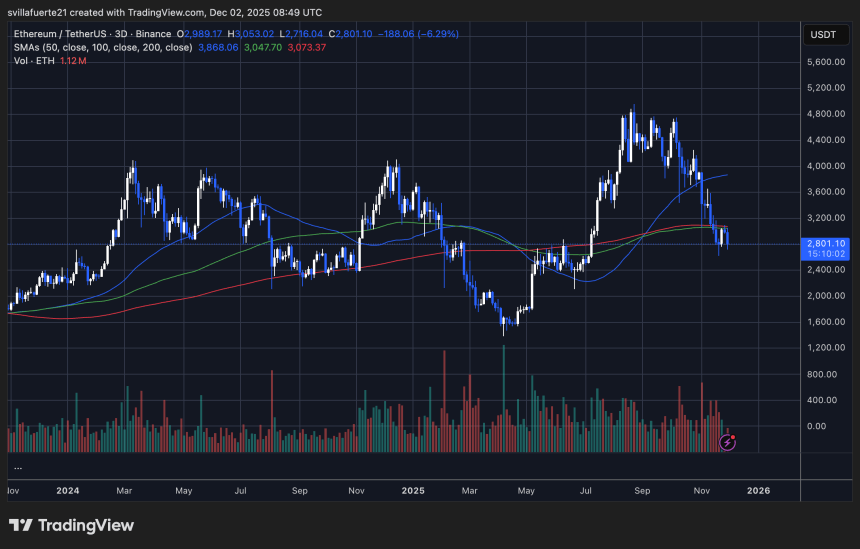
The 50 SMA has now crossed below the 100 SMA, with both indicators beginning to converge downward toward the 200 SMA—a configuration that typically precedes sustained corrections. Volume has surged on bearish candles, indicating that sellers remain in control, and there is little evidence of aggressive dip-buying. The most recent candle wick toward $2,700 highlights vulnerability rather than strength, suggesting that buyers are hesitant to defend this level with conviction.
Additionally, Ethereum is forming a series of lower highs and lower lows, further confirming a bearish market structure. If the price breaks cleanly below $2,750, the next significant liquidity zones are likely to be around $2,550 and $2,300, where previous consolidations occurred earlier in the cycle.
Understanding the Implications of Ethereum’s Market Reset
The current market reset for Ethereum is not just a temporary setback; it reflects deeper issues within the cryptocurrency ecosystem. Here are some key implications of this reset:
- Market Sentiment: The drastic reduction in open interest indicates a shift in market sentiment, with many investors opting to exit rather than take on additional risk.
- Long-term Viability: While the current conditions may seem dire, they could pave the way for a more sustainable market environment in the future.
- Investment Strategies: Investors may need to reassess their strategies, focusing on long-term value rather than short-term gains.
- Regulatory Impact: Increased scrutiny from regulators could further influence market dynamics, especially as the industry matures.
In 2026, as the market continues to evolve, it will be crucial for investors to stay informed about these trends and adjust their strategies accordingly.
Conclusion
The recent halving of Ethereum’s open interest and the significant decline in its price signal a critical moment for the cryptocurrency. As the market undergoes a reset, investors must navigate the complexities of a shifting landscape. While the current conditions may be challenging, they also present opportunities for those willing to adapt and invest in a more stable future for Ethereum.
Frequently Asked Questions (FAQ)
What does it mean when Ethereum’s open interest decreases?
A decrease in open interest indicates that there are fewer outstanding derivative contracts, suggesting that traders are closing their positions and potentially signaling a bearish market sentiment.
How does open interest affect Ethereum’s price?
Open interest can influence price movements; a significant drop may indicate a lack of confidence among traders, leading to further price declines.
What are the implications of a market reset for investors?
A market reset can lead to a healthier trading environment in the long run, but it may also require investors to reassess their strategies and risk tolerance.
What should investors look for during a market reset?
Investors should monitor key support levels, market sentiment, and overall trading volume to gauge potential recovery or further declines.
Is this the beginning of a bear market for Ethereum?
While the current conditions suggest bearish trends, it is essential to consider broader market dynamics and potential recovery signals before concluding that a bear market is underway.
Leave a Comment