
Bitcoin Coils Near Highs as Bulls Defend Gains Ahead of Critical Resistance
As of December 2025, Bitcoin has surged to $92,500, consolidating near multi-month highs and testing key resistance levels. Investors and traders are closely watching whether bullish momentum can overcome critical barriers to push BTC toward $95,000 and beyond.
- Bitcoin (BTC) climbed above $92,500, consolidating gains after a powerful rally.
- The cryptocurrency remains above the $92,000 psychological level and the 100-hourly Simple Moving Average.
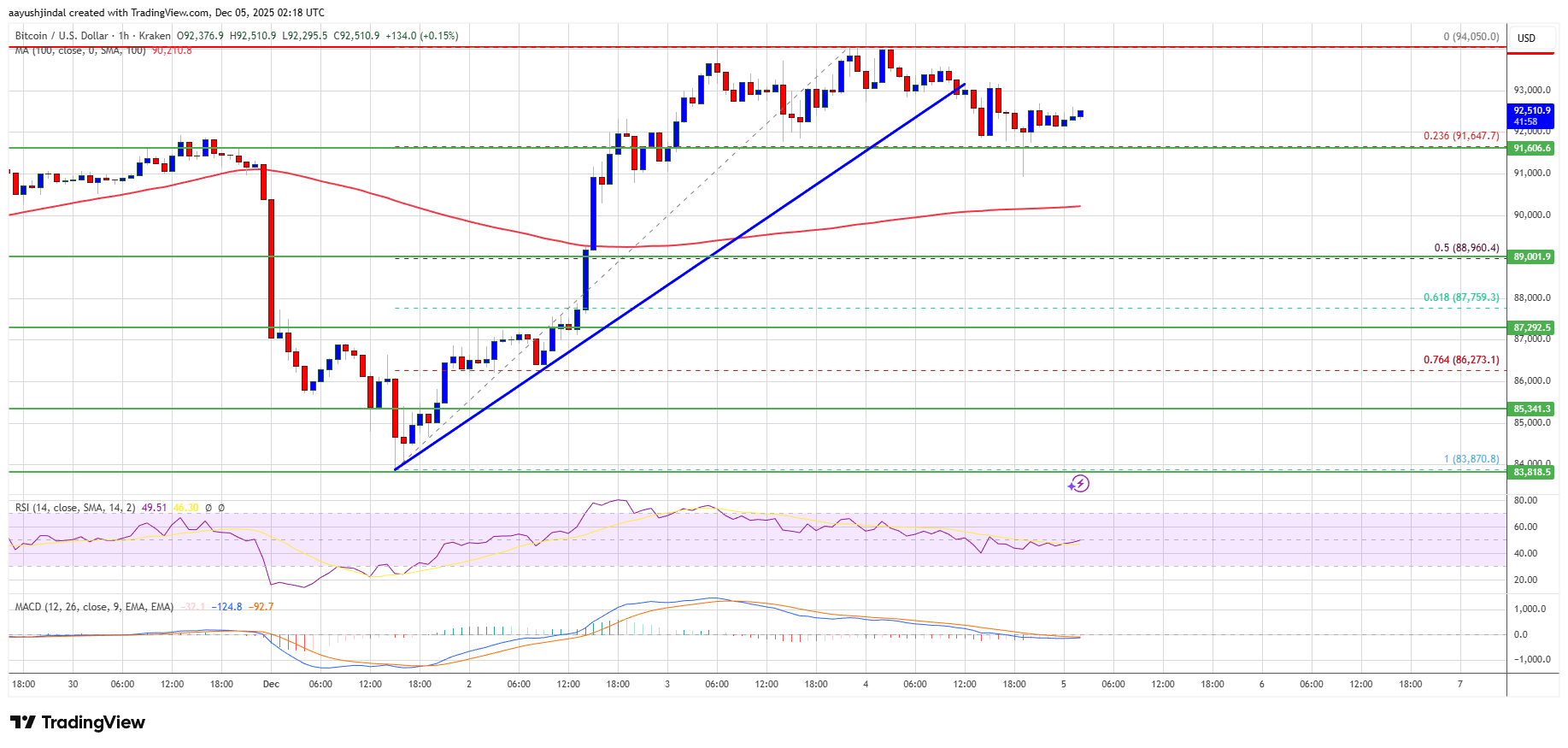
- A recent breakdown below a bullish trend line at $93,000 on hourly charts signals short-term caution.
- A sustained break above $93,500 could unlock further gains toward $94,000 and $95,000.
Bitcoin Price Analysis: Current Trends and Key Levels
Bitcoin’s price action in late 2025 reflects a classic pattern of consolidation before a potential breakout. After surging from a swing low of $83,870 to a peak of $94,050, BTC has pulled back to test key support and resistance zones. This behavior is typical during periods of high market anticipation, such as macro economic shifts or regulatory developments.
Bullish Momentum and Resistance Zones
The current consolidation phase places Bitcoin at a pivotal juncture. For bulls to regain control, BTC must hold above critical support levels and eventually break resistance at $93,000 and $94,000. Here’s a breakdown of key zones:
- Immediate Resistance: $92,800 – A breakout here could open the path to $93,000.
- Primary Resistance: $93,000 – Failure to clear this level in late 2025 has historically led to retracements.
- Major Resistance: $94,000 – A close above this threshold could trigger a rally to $95,000.
- Long-Term Target: $95,500 – The next major barrier, followed by $96,200 and $96,450.
Technical indicators suggest the rally isn’t over yet. The 23.6% Fibonacci retracement level from the recent swing low provided strong support during the pullback, a sign of underlying buying pressure. However, the hourly MACD is showing signs of weakening momentum, suggesting bulls may need fresh catalysts.
Technical Indicators Signaling Caution
While Bitcoin’s fundamentals remain strong—driven by renewed institutional interest and ETF inflows—traders should monitor these indicators:
- Hourly MACD: Losing pace in the bullish zone, indicating diminishing upward momentum.
- Hourly RSI: Below the 50 level, suggesting a short-term bearish bias.
- Trading Volume: Declining during the consolidation phase, which often precedes a breakout or breakdown.
A sustained move above the 100-hourly SMA ($92,000) is crucial for bulls. Failure to hold this level could invite further downside testing.
Potential Upside: Can Bitcoin Break $94,000?
Resistance Levels to Watch
For Bitcoin to extend its rally, it must clear several well-defined resistance zones. Each level represents a “wall” of selling pressure that bulls must overcome:
- $93,000 – A psychological and technical barrier tested multiple times in Q4 2025.
- $94,000 – The recent all-time high and a key target for analysts.
- $95,000 – The next major resistance, aligned with historical resistance from 2024.
Market analysts at NewsBTC note that a close above $94,000 could trigger automatic buy orders and drive BTC toward $96,000. However, the road won’t be smooth—whale activity and options expirations could create volatility.
Historical Resistance Breaks
Bitcoin’s history shows that breakouts above key resistance often lead to extended rallies. For example, the 2023 surge above $44,000 preceded a 70% rally over six months. Similarly, a confirmed break above $94,000 in 2025 could mirror this pattern, especially with macroeconomic tailwinds such as:
- Lower U.S. interest rates boosting risk appetite.
- Increased adoption of Bitcoin ETFs by pension funds.
- Growing institutional demand for blockchain-based reserves.
Downside Risks: What Triggers a Pullback?
While the bullish case is compelling, investors must prepare for downside risks. A failure to break $94,000 could lead to a retest of key support levels.
Support Levels and Safety Nets
Bitcoin’s immediate support zones provide a safety net for long-term holders:
- $91,650 – The first major support, reinforced by the 38.2% Fibonacci retracement level.
- $90,500 – A strong psychological level and the 50-day moving average.
- $88,950 – The 50% Fibonacci retracement from the recent rally.
- $87,200 – The ultimate buffer; a break below this could signal a deeper correction.
Factors That Could Trigger a Decline
Several catalysts could pressure Bitcoin in the short term:
– Unexpected actions from the SEC or EU regulators. - Macroeconomic shocks – A sudden rise in U.S. Treasury yields or inflation data.
- Profit-taking – Large institutional players locking in gains after the recent rally.
“Bitcoin’s current consolidation is a healthy pause before the next leg up. However, traders should watch for a breakdown below $90,500, which could accelerate selling pressure.” – Crypto analyst at NewsBTC
Expert Predictions and Investment Strategies
Analyst Forecasts
Leading analysts are divided but generally optimistic. Here’s a snapshot of recent predictions:
- Bank of America: Targets $96,000 by Q1 2026, citing ETF inflows.
- Fundstrat: Warns of short-term volatility but sees $100,000 by mid-2026.
- ARK Invest: Predicts $120,000 by 2027, driven by adoption and layer-2 growth.
Pros and Cons for Investors
Pros:
- Strong on-chain metrics (transaction volume, exchange inflows).
- Institutional adoption accelerating.
- Potential for ETF-driven price discovery.
Cons:
- Regulatory uncertainty in key markets.
- High volatility and potential for sharp corrections.
- Competition from altcoins gaining market share.
For long-term investors, this phase presents a buying opportunity if BTC holds above $90,500. Traders, however, should use tight stop-loss orders below $88,950 to manage risk.
Conclusion
Bitcoin’s current consolidation near $92,500 is a classic pre-breakout phase. The cryptocurrency’s ability to defend $92,000 and retest resistance at $93,000 will determine its short-term trajectory. While upside potential toward $95,000 remains strong, investors must respect key support levels and stay alert to macroeconomic and regulatory developments.
With institutional demand firming and technical indicators flashing cautious optimism, Bitcoin remains a dominant force in the crypto market. Whether bulls can seize the moment will define the next chapter in its price story.
FAQ
What is Bitcoin’s immediate resistance level?
The immediate resistance is $93,000. A sustained break above this level is needed to open the path to $94,000.
What supports Bitcoin’s price during this consolidation?
Key supports include $92,000 (100-hourly SMA) and $91,650 (Fibonacci retracement level).
Could Bitcoin fall below $90,000?
Yes. A breakdown below $90,500 could trigger a retest of $88,950 and $87,200, especially if macroeconomic data disappoints.
What are the long-term targets for Bitcoin?
Analysts see potential for Bitcoin to reach $95,000 in late 2025, with longer-term targets of $100,000–$120,000 by 2027.
How does ETF adoption impact Bitcoin’s price?
ETF inflows increase liquidity and bring institutional capital,often leading to sustained price appreciation and reduced volatility over time.
Leave a Comment