
Dogecoin Wallet Accumulation Signals Possible Rally Amid Price Slump
Intro: What on-chain activity is telling us about Dogecoin
Dogecoin has wandered in the mid-$0.13s after a recent downturn, yet on-chain analytics are painting a bullish subtext beneath the daily price chatter. Data from Santiment shows persistent accumulation by larger holders—specifically wallets holding between 1 million DOGE and 100 million DOGE—while the price action itself struggles to muster fresh momentum. This juxtaposition—strong wallet inflows against stubborn price action—suggests a shift in conviction that could precede a future move, even if catalysts remain modest in the near term.
As the asset ecosystem quivers with volatility, the quiet accumulation by significant stakeholders becomes an important signal for traders and researchers alike. In this update, LegacyWire dives into what the wallet data actually shows, why larger holders might be stacking DOGE at these levels, and what could unfold next for Dogecoin as a meme-coin with genuine liquidity and social traction. We’ll also weigh the potential catalysts that could push Dogecoin higher and the risks that could derail a rally.
What the Wallet Data Is Saying
On-chain data provider Santiment has highlighted a notable rise in DOGE holdings among a specific band of wallets. The wallets in focus—those holding between 1 million DOGE and 100 million DOGE—have increased their combined balance from roughly 27.79 billion DOGE on December 3 to about 28.34 billion DOGE at the time of writing. In practical terms, that’s an inflow of around 550 million DOGE in roughly 48 hours. This magnitude matters for a few reasons: it represents a meaningful portion of the circulating supply being moved into larger hands, and it occurs even as the price has not shown a decisive upside breakout.
For readers tracking the behavior of “whale-tier” holders, this shift is particularly noteworthy because it contrasts with several weeks of net distribution. The transition from selling pressure to accumulation signals a re-evaluation of DOGE’s fair value by some of the market’s most persistent participants. It’s worth noting that such behavior often precedes a consolidation phase or, in favorable conditions, a breakout move if retail sentiment is subdued and fewer coins are being dumped onto the market.
In broader context, Dogecoin’s on-chain activity still trails the exuberance of peak bull markets, but the increased reserve buildup among larger wallets implies confidence in DOGE’s longer-term store of value and liquidity profile. When fewer coins are available to the average trader, price dynamics can tighten, creating a scenario where a modest influx of demand—whether from retail buyers or a new wave of institutional interest—could produce a more pronounced price reaction.
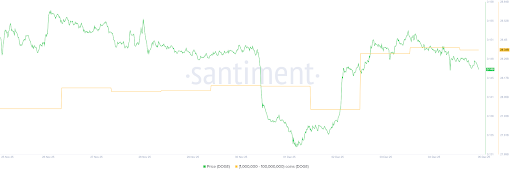
As a reminder, on-chain indicators are best interpreted as complementary to price action and market sentiment. The DOGE accumulation trend highlighted by Santiment aligns with a broader narrative: that large holders may be signaling a longer time horizon for DOGE and an expectation that the price will eventually reflect its fundamentals within a liquid and widely traded ecosystem.
The Whale Activity: Numbers Behind the Trend
Who are the wallets involved?
The “whale tier” in this analysis refers to wallets holding between 1 million DOGE and 100 million DOGE. While not the largest addresses in the market, this cohort forms a reliable proxy for mid-size to large-scale accumulation. Together, their aggregated balances can influence supply dynamics more than smaller retail wallets because their trades represent a meaningful percentage of daily volume and available liquidity. In Dogecoin’s current market structure, even hundreds of millions of DOGE can have a disproportionate effect on how tight or loose the circulating supply feels to market participants.
What the numbers imply for supply dynamics
When a sizable portion of the circulating DOGE is tucked away in fewer hands, the immediate liquidity available to the broader market can marginally contract. This is not a guaranteed price driver, but it sets the stage for price stability or an upward tilt if demand begins to re-enter aggressively. It also signals that the market’s most informed or capital-endowed participants see favorable risk-adjusted returns at current price levels.
Historical perspective: accumulation vs. distribution cycles
Analysts often emphasize that accumulation by whales can be a precursor to a price respite or rally, particularly when the market has experienced a prolonged phase of distribution. In Dogecoin’s case, the recent reversal from late-October through early December—when large holders were reducing balances—gave way to a fresh accumulation pattern. That transition is important because it may reflect a change in the risk calculus: DOGE is no longer treated as primarily a speculative meme asset by some investors, but rather as a liquid stake with a potential to participate in broader crypto market cycles once macro conditions improve.
Technical View: Levels to Watch and What They Mean
Beyond on-chain data, technical analysis provides a framework for understanding potential future price moves. Several chartists point to key support and resistance thresholds that could determine whether the current accumulation translates into a sustained uptrend.
- Critical support around $0.138: A consistent move above this level would be interpreted by many analysts as a sign that a bottom may be forming and the selling pressure has abated.
- Recent intraday high near $0.1504: The brief rally to this level demonstrates that buyers are stepping in at higher prints, albeit with limited follow-through so far.
- Resistance near $0.16–$0.17: If DOGE can clear this zone with conviction, the next phase of the rally would likely require sustained buying pressure and positive news flow.
- Macro risk ceiling around $0.20–$0.25: For many market participants, this band marks a psychological shift where DOGE would begin to attract more attention from risk managers and portfolio allocators.
Analysts also emphasize the role of on-chain accumulation in conjunction with price action. When prices approach technical resistance, a robust inflow of DOGE to exchanges or a surge in retail buying can be the catalyst that finally drives a breakout. Conversely, if the accumulation rate slows or if macro conditions deteriorate, the previously built-up supply constraints could ease, reducing the probability of a sharp rally.
In a broader sense, the technical roadmap for Dogecoin remains contingent on market-wide liquidity and sentiment. A clean breakout would likely require a combination of on-chain support, favorable macro conditions, and the absence of negative exogenous shocks. The current on-chain picture—paired with a cautious price structure—suggests that the path of least resistance is a slow, grind higher rather than a dramatic moonshot in the near term.

Trading-level perspectives vary, but the convergence of on-chain accumulation and technical resistance levels typically warrants close monitoring. If Dogecoin can maintain price levels above $0.138 and begin forming a sequence of higher highs and higher lows, the probability of a sustained rally increases. In the event accumulation wanes or the price falls back below critical support, the risk of a renewed downturn rises, underscoring the importance of watching both on-chain signals and price action in tandem.
Market Sentiment, Catalysts, and Potential Scenarios
The recent on-chain shifts come amid a broader crypto market backdrop that has shown episodic strength but remains highly reactive to macro risk-on/off dynamics, liquidity conditions, and social sentiment. For DOGE, a few catalysts could meaningfully tilt the risk-reward balance:
- Improved retail sentiment: When social and retail enthusiasm returns, demand tends to pick up faster than the rate at which whales accumulate, potentially accelerating a rally.
- Liquidity improvements: In periods when market makers and major exchanges provide deeper liquidity for DOGE, price swings can become more manageable, enabling a constructive breakout from key levels.
- Broader crypto market strength: DOGE often benefits when BTC and major altcoins rise, as risk appetite returns and speculative appetite broadens.
- Macro risk-on sentiment:
In a favorable macro environment—lower interest rates, stable inflation, or positive policy signals—investors may reallocate into higher-beta assets like meme coins with proven liquidity and social utility. - News-driven momentum: Partnerships, exchange listings, or notable adoption cases can create short-term upward pressure, especially if coupled with on-chain accumulation.
Conversely, several headwinds could undermine the bull case: persistent macro headwinds, a renewed wave of sell pressure from large holders, or a loss of on-chain conviction if the price fails to consolidate above critical levels for an extended period.
Pros, Cons, and What It All Means for Investors
As with any discussion about meme-based or highly speculative assets, there are clear pros and cons to consider when interpreting the current Dogecoin signal set.
- Pros:
- On-chain accumulation by whale-tier wallets can indicate confidence in longer-term value and a willingness to weather volatility.
- Price stability around key levels like $0.138 could set the stage for a breakout if demand returns.
- Dogecoin’s liquidity profile and large user base provide a robust foundation for potential gains if market sentiment improves.
- Cons:
- The meme-driven narrative can cap upside potential if broader crypto markets fail to rally or if regulatory concerns escalate.
- Consolidation without a decisive breakout may leave late buyers exposed to a renewed downtrend.
- Heavy reliance on on-chain signals means prices can diverge from wallet activity for periods, complicating short-term forecasting.
In practice, investors should balance on-chain insights with risk management. Position sizing, stop-loss discipline, and alignment with a broader crypto portfolio strategy can help navigate the uncertainties inherent in DOGE trading. As always, diversification remains a prudent approach to mitigating idiosyncratic risk associated with meme assets and their sometimes unpredictable price action.
Conclusion: Is a surge coming for Dogecoin?
The latest on-chain data shows a meaningful shift: larger DOGE holders are increasing their wallets while the price remains range-bound in the mid-$0.13s. This combination—quiet accumulation amid a lackluster price action—is a classic setup that could precede a period of renewed interest, especially if Dogecoin can break above critical resistance and sustain higher prints. The immediate near-term path is likely to be determined by a blend of market breadth (retail and institutional demand), macro liquidity, and how well DOGE can hold above key technical levels.
Technical analysts are watching the region around $0.138 as a telltale threshold. A breakout sustained above this level would enhance the case for a multi-week rally, while a failure to hold could renew selling pressure, potentially erasing recent gains. Some independent analysts have floated longer-term targets in the vicinity of $0.70 to $0.75 as potential upside outcomes, though such forecasts should be treated with caution given DOGE’s volatile and sentiment-driven nature.
For now, the narrative centers on a practical takeaway: accumulation by the 1M–100M DOGE wallet cohort is a meaningful counterpoint to price stagnation, suggesting that investors with substantial exposure still see room for DOGE to perform when market conditions align. Traders should monitor both on-chain dynamics and price action, as a confluence of the two would provide a more reliable signal of a potential DOGE rally than either factor alone.
FAQ
Why does wallet accumulation matter for Dogecoin’s price?
Wallet accumulation matters because it reflects the demand side of the supply equation. When large holders accumulate DOGE, they are effectively tightening the available circulating supply. If retail selling subsides and demand returns, the reduced liquidity can help support higher prices. However, in a highly volatile market, accumulation alone may not guarantee a rally; it must be complemented by broader market participation and favorable liquidity conditions.
What levels are crucial to watch for a possible breakout?
Key levels include the critical support around $0.138 and resistance around $0.16–$0.17. A convincing close above $0.138 would be seen as a positive technical signal, potentially paving the way for a test of the $0.16–$0.17 zone. If that resistance is cleared with sustained volume, a move toward higher targets—potentially up to $0.70–$0.75 in a stronger macro environment—could become more plausible.
Could Dogecoin realistically reach $0.70–$0.75 in the near term?
A move into the $0.70–$0.75 range would require a combination of broad crypto-market strength, renewed retail enthusiasm, and favorable on-chain dynamics that persist beyond a few weeks. While some analysts have proposed such targets based on extrapolated technical models, it is important to treat them as potential scenarios rather than guaranteed outcomes, given the volatility and meme-driven nature of Dogecoin.
What are the main risks facing DOGE investors today?
Main risks include a renewed wave of selling pressure from large holders, a downturn in broader crypto markets, negative regulatory developments impacting meme assets, and a continuation of low retail participation. Additionally, if on-chain accumulation slows or if price action fails to hold above critical levels, the probability of a renewed downtrend increases.
How should investors balance on-chain signals with price action?
Investors should treat on-chain signals as supplementary to price action and market sentiment. A holistic approach combines wallet activity metrics with traditional technical analysis, macro indicators, and risk management practices. This reduces dependence on any single signal and helps avoid overreacting to short-term moves driven by noise in the market.
Are there any credible external data points that reinforce the on-chain signal?
Yes. In addition to Santiment’s on-chain data, observers monitor exchange flow data, trading volume, and social sentiment metrics. When these indicators align with on-chain accumulation—such as rising buying pressure on exchanges, an uptick in buying volume, and positive social chatter—the case for a potential rally strengthens. Conversely, discordant signals across these metrics can warn of a possible pullback or extended consolidation.
Leave a Comment