
Bitcoin Open Interest: Glassnode Analysts Call Perpetual Futures a Ghost Town as Markets Quiet
In a striking assessment from a premier on-chain research team, Glassnode notes that Bitcoin Open Interest in perpetual futures markets has cooled to levels that many market observers describe as a ghost town. The observation underscores a broader trend: traders are stepping back from loaded leverage, and liquidity across major derivatives venues is thinning as macro headlines rally and retreat in waves. For readers tracking crypto market dynamics, this isn’t merely a statistic; it signals how risk appetite, hedging activity, and price discovery behave when speculative capital recedes from high-leverage bets.
Bitcoin Open Interest: The latest numbers and what they imply for price action
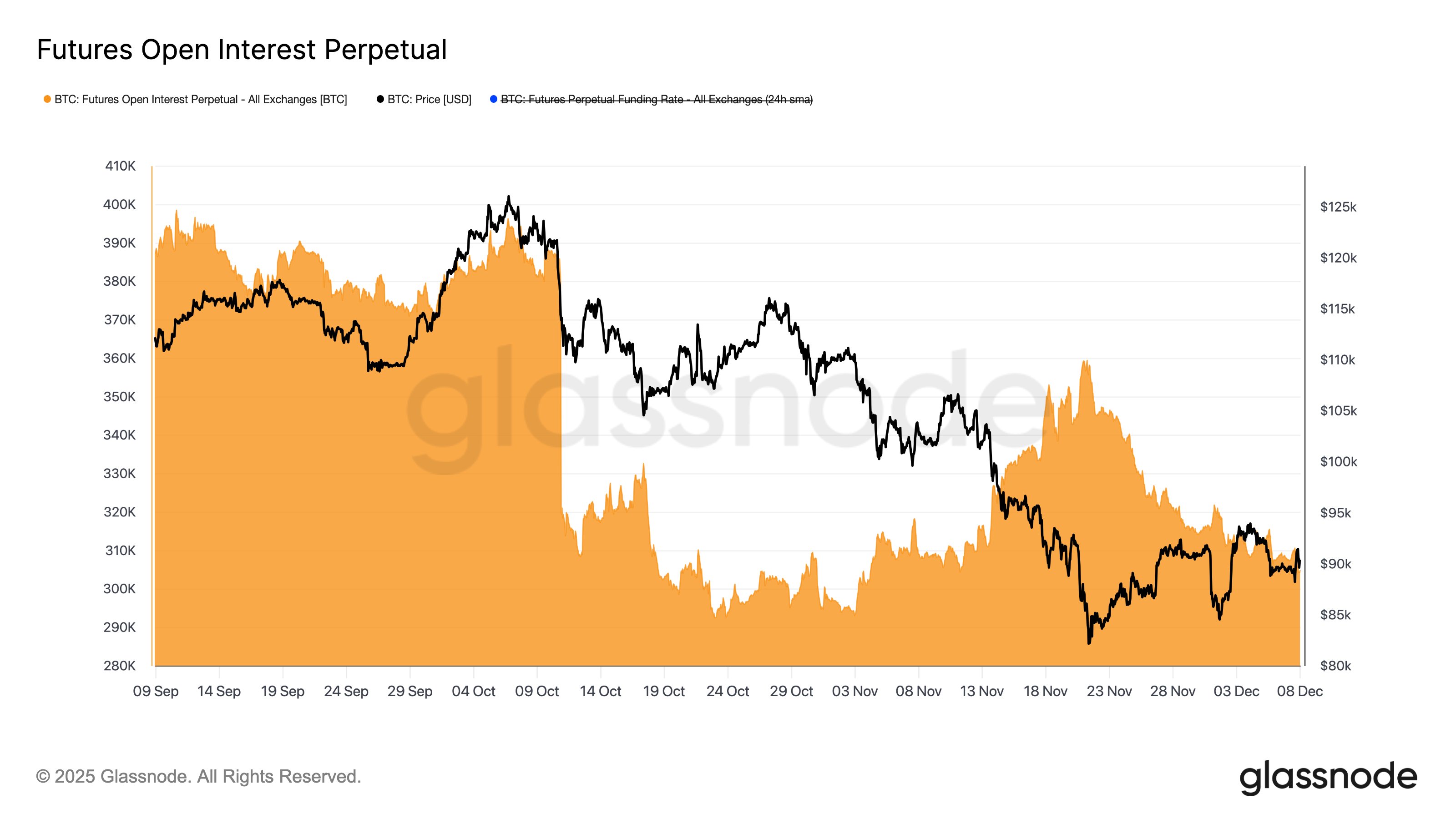
The Open Interest metric — a gauge of the total size of outstanding derivative positions across leading centralized platforms — serves as a barometer of participants’ willingness to carry risk. When Bitcoin Open Interest climbs, it often accompanies fresh leverage and heightened potential for rapid swings; when it declines, it can presage steadier price action as positions unwind or liquidations clear the field. Glassnode’s CryptoVizArt.₿ highlights that the current regime shows Open Interest in BTC-denominated perpetual futures struggling to rise above multi-month lows.
To put the numbers in context, the BTC-denominated Open Interest has hovered around sub-310,000 BTC in recent weeks, a level reminiscent of the post-crash clearing in October. This is not simply a reflection of price; it reveals a shift in trader conviction. Institutions and sophisticated traders—traditionally more inclined to use perpetuals to hedge or gain directional exposure—appear to be adopting a cautious stance, even as the underlying spot market exhibits episodes of volatility. The result is a market where new long bets are scarce and existing positions stand as a smaller fraction of total activity, contributing to a more labored price discovery process.
Earlier in October, a sharp price decline triggered a massive flush of highly leveraged positions. The subsequent weeks saw Open Interest drift sideways near these lows, suggesting a consolidating phase where fear and uncertainty outweighed the appetite for fresh leverage. Then, in mid-November, there was a perceptible uptick in speculative activity as Bitcoin’s price trajectory remained pressured, and the Open Interest rallied briefly to a level that some analysts described as testing a bottom. Since that peak, the metric refuted expectations of a sustained breakout and cooled again, reinforcing the ghost-town narrative among perpetual futures traders.
To paint a more precise picture, consider the relationship between Open Interest and price volatility. A rising Open Interest often coincides with new leverage chasing price reversals, amplifying moves. Conversely, a falling Open Interest can indicate positions being closed out and a reduction in systemic risk from highly leveraged bets. In this cycle, the perpetual futures market has shown the latter: a subdued, cautious posture where participants prefer to wait on clearer catalysts rather than chase high-risk bets. This dynamic aligns with the broader liquidity backdrop across crypto venues, where risk-off sentiment can compress both volatility and turnover.
Graphic data shared by CryptoVizArt.₿ demonstrates the color-coded evolution of BTC Open Interest across the latest months. While a few localized spikes punctuate the trend, the overall channel remains subdued relative to the gains seen in previous bull phases. The takeaway for analysts is that open interest, as a structural measure, is signaling restrained participation rather than outright bearish rejection of crypto or a sudden capitulation to downside risk. This distinction matters for traders who rely on liquidity and leverage dynamics to manage risk and optimize entry and exit points.
Beyond the outright numbers, the narrative around Bitcoin Open Interest intersects with several peripheral indicators. The ongoing fade in the perpetual futures Funding Rate — which tracks the periodic fees exchanged between long and short positions — corroborates the story: long-side conviction has softened, and traders are less willing to pay a premium for upside exposure. When funding costs retreat, it often reflects a convergence of expectations about future price direction and a preference for hedges or spot accumulation rather than sustained leveraged bets. Glassnode underscores this linkage by noting the sequential drift in funding rates as one of the confirmations of a cautious market posture.
Why Open Interest matters for Bitcoin traders and the broader market
Open Interest is more than a headline number; it is a lens on risk appetite and capital allocation in the derivatives ecosystem. For a market like Bitcoin, where liquidity is fragmented across dozens of centralized exchanges, a low Open Interest signals fewer counterparties willing to hold large, leveraged bets. This can reduce the chance of a sudden, margin-driven cascade but may also limit upside momentum because fewer bets are aligned with a price move. In practical terms, a muted Open Interest often translates to tighter bid-ask spreads in futures and less explosive liquidations during sharp price moves, which in turn shapes the day-to-day price action and the reliability of trend-following strategies.
The glass-half-full interpretation is that a quiet Open Interest regime helps cool excessive volatility and can create a more orderly market environment. The glass-half-empty view warns that without robust participation from institutional players and margin-friendly liquidity, Bitcoin might struggle to sustain meaningful rallies, even when macro conditions tilt favorably. The feedback loop between Open Interest and price is nuanced: subdued leverage can limit upside spikes, but it also dampens downside spikes by reducing the velocity of margin calls. For risk managers, this means recalibrating stop-loss levels, re-looking at hedging horizons, and acknowledging that liquidity risk remains a constant companion even when the narrative looks calm on the surface.
In a broader sense, Bitcoin Open Interest interacts with other facets of the crypto market structure. Perpetual futures are designed to mirror the price of the underlying asset but with built-in roll mechanics and funding payments that keep the contract tethered to the spot market. When Open Interest is low, even small shifts in funding rates can disproportionately influence trader behavior because there is less liquidity to absorb shocks. In contrast, periods of high Open Interest often accompany stronger liquidity cushions but can also amplify moves if liquidations cascade during market stress. Right now, the balance tilts toward caution, a stance that aligns with a prudent risk management culture among both retail traders and professional funds alike.
The October collapse, liquidations, and the reopening of risk flows
October’s dramatic price drop sent a shock through the Bitcoin Open Interest landscape. The event triggered massive liquidations, wiping out a large portion of leveraged bets and driving Open Interest toward new pseudo-lows. The aftermath was a retrenchment phase: participants reevaluated risk, pared back exposure, and waited for clearer catalysts before re-entering the market with the sort of confidence that characterizes earlier bull cycles. This post-crash re-pricing often produces a temporary lull in open interest as the market digests the damage and pricing channels begin to normalize.
November dynamics: a tentative uptick followed by cooling
In mid-November, the perpetual futures community observed a fleeting uptick in speculative activity, with the Open Interest cresting briefly in tandem with a deeper drawdown of the Bitcoin price. The move suggested some hedge funds and momentum traders were testing the waters, perhaps anticipating a relief rally or attempting to tilt risk budgets toward short-term gains. However, the subsequent signal remained mixed, and the index retreated toward the lows, reinforcing the narrative of a cautious market with limited appetite for aggressive leverage. The pattern echoes a broader macro backdrop where investors weigh inflation trends, interest rate expectations, and regulatory cues while maintaining vigilance on the crypto-specific liquidity cycle.
For readers seeking a practical takeaway, the October-to-November sequence illustrates how Open Interest can pivot quickly in response to external shocks, only to settle back when leverage risk is cleared and the market awaits a more definitive directional impulse. The contraction and re-expansion cycle of Open Interest is a reminder that derivatives markets are upstream risk indicators for the spot market, but they do not move in a vacuum. The health of Bitcoin Open Interest ultimately depends on the symmetry of price catalysts, risk tolerance, and the capacity of exchanges to provide robust liquidity during periods of volatility.
Funding Rate and leverage: diagnosing market conviction
The Funding Rate serves as a quick barometer of how whoever holds long positions is seeking to persuade shorts to stay in the game, and vice versa. A persistent drift lower in the Funding Rate, as observed recently, points to a waning appetite for premium upside exposure. In plain terms, it’s cheaper, on average, to hold a long perpetual futures position than to close it, which can reflect traders’ willingness to finance longer-term bets or to adopt a neutral posture while market conditions crystallize. Glassnode’s researchers emphasize that the downward trajectory of the Funding Rate aligns with a broader trend of reduced leverage in the perpetuals market, which in turn helps explain the quiet Open Interest environment observed today.
From a risk-management perspective, a declining Funding Rate can be a reason to rebalance portfolios, consider hedge alternatives, or re-allocate capital toward more robust hedges or toward spot accumulation strategies. For market watchers, it’s a signal that the market is prioritizing preservation of capital over aggressive upside, at least for the near term. This stance often translates into a more measured pace of gains or losses, which traders can model using risk budgets, scenario analysis, and probabilistic forecasting rather than relying on momentum-driven plays.
BTC price context: how the price action ties into Open Interest trends
As of today’s close, Bitcoin trades around $90,500, marking a gain of roughly 6% over the previous seven days. The price action sits within a broader range that has characterized the last several months, where bursts of upside have been tempered by liquidity constraints and shifting risk appetites. The current price backdrop matters because it interacts with Open Interest in meaningful ways: sustained price strength without commensurate growth in Open Interest can indicate that rallies are being financed by a smaller pool of participants, which may yield shallower, more fragile advances. Conversely, any renewed enthusiasm to push Open Interest higher would likely accompany a more compelling narrative or a palate of favorable macro data to attract new leverage and position builders.
The chart-tied reality is that price movements and Open Interest are now interlocked in a careful choreography. Traders and analysts are watching for a breakout that can lift Open Interest in a credible way, or for a sustained move that re-enters a risk-on phase. Until such a catalyst emerges, the ghost-town metaphor remains apt: the market’s speculative engine is idling, even if the price engine continues to churn on the underlying supply-demand dynamics and macro influences that drive investor sentiment.
For readers following the liquidity story, it’s worth noting how Open Interest and price tend to respond to shifts in market structure. If more exchanges implement favorable margining conditions and institutions demonstrate a renewed willingness to deploy capital, Open Interest could reaccelerate, bringing with it more dynamic price action and a higher likelihood of sharper corrections. If, on the other hand, macro headwinds persist and risk-off behavior dominates, the Open Interest might remain pinned near current levels, limiting the scope for large directional moves in Bitcoin’s price.
Strategic takeaways for traders and investors
- Risks: A low Bitcoin Open Interest signals thinner market depth, which can magnify price swings when events occur but also reduces the velocity of liquidations during downturns.
- Opportunities: An eventual reaccumulation of Open Interest could accompany the emergence of new hedging strategies, giving traders additional avenues to manage risk or express directional bets with improved risk controls.
- Hedging: For risk-averse participants, hedging in the perpetuals market remains a viable approach, but it should be paired with robust stop mechanisms and a clear liquidation plan given a potentially lower liquidity cushion.
- Strategy alignment: Investors should align derivatives tactics with a disciplined framework—combining price action analysis, on-chain signals, and liquidity considerations to identify entry and exit opportunities.
- Macro anchors: Inflation trends, central bank policy signals, and regulatory developments should be treated as key inputs in any strategy that hinges on Bitcoin Open Interest and perpetual futures dynamics.
Limitations and caveats: interpreting Open Interest in a dynamic, evolving market
Open Interest is a powerful indicator, but it is not a crystal ball. Several factors can distort its readings, including changes in exchange margin requirements, shifts in funding rate mechanics, and the introduction of new products or venues. Moreover, the crypto market’s fragmented liquidity and the rapid evolution of derivatives ecosystems mean that single-mauge conclusions should be avoided. Analysts at Glassnode emphasize triangulating Open Interest with funding rates, price action, and on-chain metrics to build a more accurate read of market risk appetite and potential future moves.
As always, investors should be mindful of the time horizon they operate on. Short-term traders may experience more pronounced effects from sudden liquidity gaps, while longer-term holders should watch for structural shifts in derivatives participation that could reframe the risk-reward profile over months rather than days. The current narrative—a muted Bitcoin Open Interest combined with a cooling funding rate—is a snapshot of a moment in a long-running cycle that will evolve as market participants reallocate capital and new drivers emerge.
Conclusion: what the ghost town means for LegacyWire readers
The latest read on Bitcoin Open Interest in perpetual futures markets is a reminder that market enthusiasm is not a constant. Glassnode’s analysis points to a period of caution, where risk-taking activity has cooled, even as prices hold above critical levels. For readers of LegacyWire—Only Important News—this combination of subdued Open Interest and softer funding rates signals that traders are prioritizing capital preservation and careful hedging over aggressive leverage. In such an environment, meaningful price moves are more likely to occur in response to clear macro or sector-specific catalysts rather than to gradual, momentum-driven rises.
From a journalistic perspective, the story is not merely about numbers; it is about the psychology of a market at a crossroads. The ghost-town characterization of the perpetual futures arena reflects a reset: investors are re-evaluating risk budgets, exchanges are recalibrating leverage and margins, and market participants are seeking clarity before re-entering the chase for outsized gains. The takeaway for readers is simple: stay informed, diversify your risk, and keep a close watch on how Open Interest and Funding Rates move in tandem with Bitcoin’s price and macro developments.
FAQ: common questions about Bitcoin Open Interest and perpetual futures
- What is Bitcoin Open Interest? Bitcoin Open Interest is the total number of outstanding derivative contracts, such as perpetual futures, that have not yet been settled. It serves as a gauge of how many positions are actively held across exchanges, indicating market engagement and risk appetite.
- Why does Open Interest matter for price action? Open Interest reflects the level of leverage and market participation. When it rises, new money is entering, which can amplify moves; when it falls, positions are being unwound, which can dampen volatility.
- What caused the October liquidation event mentioned by analysts? A sharp drop in Bitcoin’s price in October triggered a cascade of liquidations as leveraged bets were forced to close, reducing liquidity and pushing the market toward a temporary equilibrium with lower Open Interest.
- How does Funding Rate relate to Open Interest? Funding Rate indicates the cost to hold long or short positions. A persistent drop suggests traders are less eager to pay a premium for upside exposure, aligning with a cautious Open Interest regime.
- Can low Open Interest signal a bull move in the future? It can, if new capital and favorable catalysts enter the market, bringing fresh leverage and increasing liquidity. However, it can also mean a prolonged period of consolidation if there is no renewed demand.
- What should traders monitor besides Open Interest? Traders should monitor the Funding Rate, price action, on-chain metrics, exchange liquidity, and macro indicators to form a holistic view of market risk and potential moves.
- Is this situation permanent or temporary? Market regimes shift. The current muted Open Interest could reverse if institutional participation returns, margin conditions improve, or a clear bullish or bearish catalyst appears, but timing remains uncertain.
Leave a Comment