
Bitcoin Active Addresses Slide As ETF Era Rewinds Market Participation — Here’s Why
Bitcoin’s on-chain activity has slowed noticeably since spot Bitcoin exchange-traded funds (ETFs) entered the scene, even as institutional inflows into these products have accelerated. The contrast between more sophisticated Wall Street participation and shrinking grassroots activity is prompting a rethink of what “Bitcoin adoption” really means in a financial system that now sits at the intersection of traditional markets and decentralized technology.
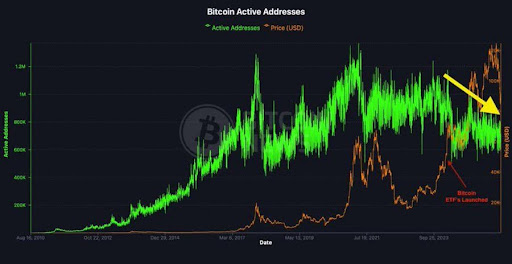
In a revealing X post, SwanDesk CEO and financial analyst Jacob King highlighted a persistent decline in Bitcoin active addresses since the US spot BTC ETFs launched in January 2024, underscoring a tension that many market watchers describe as ironic: institutions chase exposure while everyday participants retreat. The tweet, shared with his characteristic clarity, has become a focal point for discussions about how much of Bitcoin’s value proposition remains rooted in user-controlled on-chain activity versus price exposure through institutional products.
The ETF Era and On-Chain Activity
For years, Bitcoin maximalists argued that Wall Street participation would unleash a broad, practical adoption of the network. The logic was straightforward: if more capital flowed into BTC through regulated, accessible vehicles, then liquidity and price discovery would improve while the global user base grew. In practice, however, the opposite drift has appeared on-chain. Active addresses—the number of distinct Bitcoin sending or receiving addresses engaged in transactions—have trended lower even as ETF inflows rise. This divergence raises an essential question: is on-chain participation a reliable proxy for Bitcoin’s real-world utility, or has a new form of participation—through financial instruments—come to dominate the narrative?
As King notes, a subset of Bitcoiners rushed into the ETF space for a quick, early-mover advantage, seeking a favorable price impulse or a convenient entry point. After that initial wave, many participants exited or reduced their on-chain activity, leaving a market that behaves more like a proxy for sentiment and macro flows than a living ecosystem of users moving value on the network. The broader implication is not that ETFs are categorically bad for Bitcoin, but that the nature of ownership and participation is shifting in ways that may redefine what “network effect” means in a mature market environment.
Market observers have pointed to a broader pattern: ETF-driven demand tends to concentrate ownership among large holders and institutions, while retail users pursue different priorities—cost efficiency, self-custody, speed, and censorship-resistance—often via other layers of the ecosystem. The result is a bifurcation where institutional exposure can coexist with, yet not fully mirror, the health signals drawn from on-chain activity. This tension has tangible consequences for price dynamics, liquidity distribution, and the pace at which Bitcoin’s network grows in terms of settlements and sector-wide participation.
Note: The debate around on-chain metrics versus ETF-driven participation is ongoing, with researchers and traders offering varied interpretations of what constitutes a healthy level of activity for Bitcoin’s long-term value proposition.
Retail Fatigue and Institutional Winds: Why Retail Participation Feels Subdued
In the transition to a more regulated, instrument-driven market, retail participation appears to have lost some of its former momentum. The narrative that “Bitcoin is a movement of the people” has collided with the reality of financial markets where product design, custody models, and intermediary risk shape how ordinary investors interact with the asset. As ETF products provide an accessible channel for exposure, some participants may prefer holding through familiar financial platforms rather than interacting directly with the Bitcoin network. That shift can yield a lower number of active addresses even as price action remains sensitive to macro developments and institutional flows.
This dynamic has led to a paradox: ETF investors benefit from liquidity and ease of access, but the same mechanism can elicit a move away from hands-on ownership. When investors avoid holding BTC in self-custody or in non-custodial environments, the on-chain footprint—transactions and address activity—can recede, even as the overall market sees upward price pressure via regulated vehicles. The practical effect is a market that is increasingly efficient in terms of financial engineering yet potentially thinner in terms of grassroots participation and the day-to-day use cases that once drove adoption.
From a storytelling perspective, the ETF effect challenges the traditional image of Bitcoin as a purely peer-to-peer, reserve-type asset. Instead, it positions BTC within the mosaic of regulated investment products, where the primary driver of value may shift toward macro risk appetite, algorithmic trading strategies, and fund management dynamics. For researchers and traders, the key question becomes how to reconcile on-chain health metrics with the tailwinds of ETF-driven liquidity and what that means for future cycles.
Analysts tracking institutional inflows point to several converging forces: increased adoption of index-linked Bitcoin products, growing penetration of family offices and hedge funds, and the gradual normalization of BTC exposure across major asset classes. Yet the same forces can dampen the activity that arises when users interact directly with the network, leading to what one observer described as “proxy trading”—a scenario in which price discovery occurs in the derivatives and ETF markets rather than in the on-chain economy.
In a broader sense, the ETF era invites a reconsideration of Bitcoin’s competing narratives. Is Bitcoin a digital money system that people use to settle real-world value, or is it a digital gold-like instrument whose value is mostly a function of risk capital and macro trends? The answer may lie in a blended future where ETFs unlock new liquidity channels while on-chain ecosystems gradually rebuild user engagement through enhanced functionality and alternative uses such as decentralized finance and cross-chain interoperability.
Unlocking Bitcoin Without Compromising Its Core Principles
Despite headwinds on the on-chain front, Bitcoin continues to benefit from a wave of ecosystem enhancements designed to expand its reach without compromising core principles like censorship resistance and user sovereignty. In particular, decentralized finance (DeFi) innovations are reimagining the asset’s capabilities by enabling programmable, trust-minimized interactions with BTC—without forcing wrap or bridge steps that can dilute native Bitcoin value or introduce new risk vectors.
One notable development is the push to move BTC into decentralized markets in a way that preserves user control. Projects built on alternative infrastructure—bypassing the need to wrap BTC to ERC-20 tokens or to rely on centralized custodians—seek to reestablish a direct, decentralized path for Bitcoin to participate in liquidity pools, lending markets, and automated market-making (AMM) mechanisms. The expectation is that such innovations will help re-anchor Bitcoin’s on-chain activity to real economic use cases, rather than merely to speculative trading in ETF-driven vehicles.
At the forefront of this movement is the recognition that Bitcoin’s value proposition includes a robust, censorship-resistant settlement layer. If liquidity can be unlocked in a way that respects user sovereignty and reduces dependence on centralized steps, Bitcoin might regain a more tangible role in decentralized ecosystems. This shift could reaccelerate on-chain engagement over time and restore confidence that the network remains deeply embedded in the broader Web3 and DeFi landscape.
In this light, the BTC ecosystem’s next phase looks to combine the reliability of mature financial products with the innovation of decentralized primitives. Such a synthesis could yield a more resilient market structure that balances institutional access with grassroots participation, helping to preserve Bitcoin’s long-term fundamental appeal while broadening its set of use cases.

RioSwap and Mintlayer: A Case Study in Decentralized BTC Liquidity
Among the most talked-about innovations aimed at returning Bitcoin to the center of decentralized markets is RioSwap, a Decentralized Exchange (DEX) built to move BTC into DeFi ecosystems without the usual wrapping or unwrapping gymnastics. RioSwap represents a growing wave of projects that leverage native Bitcoin liquidity via secure, trust-minimized protocols. By enabling BTC to flow into decentralized markets directly, RioSwap seeks to unlock a new phase of liquidity—one where Bitcoin participates in DeFi on its own terms rather than as a wrapped asset tethered to alternative chains.
According to Mintlayer, a platform focused on native BTC liquidity and cross-chain capabilities, RioSwap is powered by a native Hashed Time-Lock Contract (HTLC) architecture. HTLCs enable conditional transfers that secure value across parties, a cornerstone for trustless exchanges and cross-chain swaps. The essential promise is that BTC can move into decentralized markets without wrapping, while the user remains in full control of their assets. Mintlayer emphasizes that this architecture avoids the complexities and custodial risks associated with bridged BTC and reduces counterparty risk, as funds are locked under programmable conditions rather than held by a third party.
As the RioSwap testnet goes live, Mintlayer anticipates a new liquidity phase for Bitcoin—one that elevates BTC from a passive asset in ETF portfolios to an active participant in decentralized markets. This evolution could help reenergize on-chain activity by offering practical DeFi use cases for BTC, including lending, liquidity provision, and yield opportunities that are native to Bitcoin rather than contingent on cross-chain wrappers. The broader implication is a more diverse, resilient Bitcoin ecosystem where the asset can demonstrate its value across multiple use cases while preserving its core principles.
While RioSwap and Mintlayer illustrate a promising path forward, observers caution that the success of native BTC DeFi hinges on user education, security guarantees, and the robustness of HTLC-based mechanisms. The learning curve for new users, the risk of bugs in decentralized protocols, and the need for reliable governance structures all factor into the ultimate adoption trajectory. Nonetheless, these initiatives underscore a broader trend: the ecosystem’s willingness to explore formats where Bitcoin can serve as the underlying settlement asset with DeFi-native functionality, without compromising its core ethos.
The macro environment surrounding Bitcoin continues to evolve, with several factors shaping investor sentiment and price action. Recent shifts in monetary policy, risk-on versus risk-off cycles, and the performance of traditional equities all interact with Bitcoin’s own supply-demand dynamics. In particular, the transition away from prolonged quantitative tightening toward easier monetary conditions has historically provided a favorable backdrop for risk assets, though Bitcoin’s behavior often diverges from classic equity patterns due to its unique set of drivers.
One notable backdrop is the Federal Reserve’s QT program evolution. After a multi-year effort that reduced the Fed’s balance sheet by trillions, the formal end of QT marked a significant policy milestone. While interest rates remained elevated, the possibility of rate cuts loomed on the horizon, potentially increasing liquidity in broader markets and affecting BTC’s risk-reward calculus. The diverging paths of global central banks—such as Europe and China—continue to influence capital flows into BTC and related ETFs, as investors reassess risk, diversification, and hedging strategies in a shifting macro landscape.
Against this backdrop, BlackRock’s iShares BTC Trust (IBIT) has emerged as a notable example of how traditional asset managers are integrating BTC into regulated portfolios. Launched in early 2024, IBIT has swiftly become a profitable anchor in BlackRock’s ETF lineup, reflecting both the demand for regulated access to BTC and the willingness of large asset managers to innovate around custody, compliance, and liquidity management. The performance and revenue profile of IBIT underscore the fact that ETF-based exposure remains a central pillar of Bitcoin’s mainstream adoption, even as the on-chain community searches for ways to re-anchor BTC’s usage and value to decentralized economics.
As this dynamic unfolds, traders and investors watch for signs of momentum reversal, liquidity resilience, and anecdotal indicators from diverse market participants. Some analysts contend that the net inflows into spot BTC ETFs could remain subdued in the short term, even as the market peers through macro relief rallies and sector-specific catalysts. Others argue that the combination of ETF-driven exposure and DeFi-enabled BTC liquidity could set the stage for a more balanced ecosystem where on-chain activity gradually recovers in tandem with institutional participation.
What This Means for Investors and the Market
From an investor’s perspective, the ETF era offers clear advantages: regulated access, price transparency, counterparty risk mitigation, and simplified custody. For institutions, the ability to gain BTC exposure without direct custody complications can accelerate portfolio construction and risk management. For some retail participants, however, the appeal of direct self-custody, personal control, and active participation in the network remains compelling. The challenge is to reconcile these competing preferences within a single market framework that remains financially dynamic and technically robust.
On balance, the ETF-driven liquidity improves price discovery and market efficiency, but it can also suppress some of the retail-driven on-chain activity that historically signaled organic demand for Bitcoin’s use as a medium of exchange. The potential upside is that as DeFi-native BTC liquidity grows through projects like RioSwap and Mintlayer, the on-chain dimension could reassert itself, offering new avenues for participation beyond traditional buy-and-hold strategies. In such a scenario, Bitcoin would not just be a macro-risk asset or a regulated investment vehicle; it would also be a programmable settlement layer with direct, user-owned liquidity channels that operate across both centralized and decentralized finance ecosystems.
Pros and cons of the ETF-led approach include the following:
- Cons: Diminished on-chain activity, potential misalignment with Bitcoin’s original peer-to-peer ethos, concentration risk among a handful of large ETF participants, and possible delayed price signals due to derivatives-driven dynamics.
As the industry negotiates these trade-offs, a growing emphasis on native BTC DeFi experiences promises to diversify participation more evenly across on-chain and off-chain channels. Projects that prioritize security, user education, and seamless UX will likely gain traction as market maturity deepens. The coming years could reveal a more nuanced picture of Bitcoin adoption—one that values both regulated access through ETFs and genuine on-chain utility through decentralized infrastructure.
Roadmap to a More Resilient Bitcoin Ecosystem
The path forward for Bitcoin’s ecosystem rests on a balance between institutional access and decentralized participation. While ETFs provide essential legitimacy and scale, the deeper, long-term resilience of Bitcoin may hinge on the ability to reframe on-chain activity as meaningful, real-world usage rather than a byproduct of trading and investment products. A few strategic themes are likely to shape this trajectory:
- Enhanced on-chain utility: With more DeFi integrations and native BTC liquidity solutions, everyday users could see tangible benefits from interacting with the Bitcoin network beyond simply buying and holding.
- Improved custody models: Advanced, user-friendly custody solutions that protect assets while offering convenient access to both ETF-based exposure and on-chain participation.
- Security-first design: Protocols that emphasize robust security guarantees, auditable code, and transparent governance to boost confidence in decentralized BTC facilities.
- Interoperability and cross-chain liquidity: Bridges and cross-chain protocols that preserve Bitcoin’s sovereignty while enabling selective, well-audited interoperability with other ecosystems.
- Clear regulatory alignment: Ongoing collaboration between traditional finance and the crypto sector to codify best practices for disclosure, risk management, and investor protection.
For investors and observers, the big takeaway is that Bitcoin’s evolution is not a single path but a spectrum of intertwined dynamics. ETFs can unlock scale and safety, while DeFi innovations can restore a more demonstrable on-chain utility. The ideal future combines the strengths of both worlds, resulting in a Bitcoin ecosystem that offers reliable access to capital markets without sacrificing the network’s core principles and potential for decentralized value transfer.
FAQ
Q: What exactly are “Bitcoin active addresses,” and why do they matter?
A: Bitcoin active addresses are the number of unique addresses that participate in sending or receiving BTC within a given period. They’re a widely watched proxy for real network usage, showing whether people and businesses are actively moving value. Critics note that this metric can be noisy and influenced by exchange activity, but it remains a useful barometer of on-chain engagement when viewed in context with other data points.
Q: Why did on-chain activity slow after the spot BTC ETFs launched?
A: The slowdown is likely multifactorial. ETFs provide a regulated, scalable way to gain exposure, which can reduce the need for direct on-chain transfers by some participants. Additionally, when retail investors crowd into ETF products, the activity may shift toward centralized platforms rather than individual wallets. Market cycles, macro liquidity conditions, and shifts in risk appetite all contribute to variations in on-chain usage over time.
Q: What is RioSwap, and how does it relate to Bitcoin’s DeFi future?
A: RioSwap is a decentralized exchange project designed to enable BTC to move into decentralized markets without wrapping the asset. It aims to preserve Bitcoin’s native sovereignty while enabling liquidity and trading in DeFi contexts. The project uses HTLC-based mechanisms to secure trustless transactions, representing a potential blueprint for BTC’s deeper DeFi integration.
Q: What is Mintlayer’s HTLC architecture, and why is it important?
A: Mintlayer’s architecture leverages Hashed Time-Lock Contracts (HTLCs) to provide secure, conditional transfers that can unlock BTC liquidity across decentralized platforms. This approach helps keep BTC under user control, reduces dependency on wrapped versions, and can lower counterparty risk in cross-chain interactions. It’s a foundational concept for native BTC DeFi activity.
Q: How might ETF participation impact Bitcoin’s price action in the near term?
A: ETFs can inject liquidity and lower the barriers to entry for large institutions, which may support bullish price momentum under certain conditions. However, if growth in on-chain activity does not keep pace with ETF-driven demand, price moves could reflect broader macro influences rather than pure network usage. The balance of these effects will depend on how DeFi liquidity and real-use cases evolve alongside institutional participation.
Q: What are the risks associated with relying on DeFi-native BTC liquidity solutions?
A: Key risks include smart contract vulnerabilities, governance challenges, and potential liquidity fragmentation across multiple protocols. Despite strong security practices, any complex DeFi system can experience bugs or exploits. Users should pursue due diligence, consider custody approaches, and stay informed about protocol audits and incident reports before participating.
Conclusion
The Bitcoin story is entering a stage where conventional financial machinery and decentralized innovation cohabit the same ecosystem. The ETF era offers scale, regulatory clarity, and broader access, which are essential for mainstream adoption. Simultaneously, DeFi-native initiatives like RioSwap and Mintlayer’s HTLC architecture promise to reclaim on-chain activity by giving Bitcoin a direct, user-controlled role in decentralized markets. If the two strands can coexist—institutional participation that respects Bitcoin’s principles and grassroots innovations that restore tangible on-chain utility—the network could achieve a balanced, resilient growth trajectory. For LegacyWire readers focused on meaningful, data-backed insights, the takeaway is clear: Bitcoin’s future participation hinges on both efficient access to capital through ETFs and practical, secure on-chain use cases that reengage everyday users in a robust, open financial system.
Leave a Comment