
Bitcoin Struggles to Regain Momentum as Realized Cap Growth Slows
On-chain data and market signals are painting a cautious picture for Bitcoin as Realized Cap Growth slips. Investors are weighing what this means for momentum, price discovery, and the duration of the current cycle.
Bitcoin Lacks Fresh Momentum As Realized Cap Growth Still Declining is not just a headline about a number on a chart; it’s a reflection of how capital moved into and out of BTC over the past year. In practical terms, the Realized Cap Growth indicator tracks how the value of Bitcoin’s supply has changed hands over a rolling window, offering a lens into net inflows and outflows that aren’t always visible in price alone. As of now, on-chain analysts are noting a slowdown in new cost-basis inflows, which could indicate buyers taking a step back even as the price sits near familiar resistance levels.
Bitcoin Realized Cap Growth Has Been Heading Down Recently
To understand what the latest data are telling us, it helps to separate two related concepts: Realized Cap and Realized Cap Growth. CryptoQuant analyst Maartunn recently highlighted, in a concise post on X, that the Realized Cap Growth metric has been trending lower in recent sessions. The Realized Cap itself is an on-chain valuation method that assigns to each bitcoin the price at which it was last moved on-chain, then sums those values. Unlike the typical market cap, which multiplies circulating supply by the current spot price, Realized Cap captures the historical cost basis of the entire supply.
In plain terms, Realized Cap shows how much capital investors collectively used to acquire and move their BTC during prior cycles. Market cap, by contrast, reflects the present valuation if every coin were sold at the current price. The difference matters: Realized Cap emphasizes where capital actually entered the market, whereas market cap reflects the price that would be needed to settle all coins at today’s price. This distinction is crucial when trying to gauge momentum and the likelihood of sustained price moves.
What matters for momentum, though, is Realized Cap Growth—the 365-day change in Realized Cap. This indicator is a proxy for net capital inflows or outflows over a year, effectively telling us whether new money continues to accumulate at or above the price where investors originally bought Bitcoin. A rising Realized Cap Growth generally points to healthy accumulation, while a decline hints that fresh money is waning or that capital is moving elsewhere.
On the latest trajectory, Maartunn’s chart shows the 7-day and 59-day moving averages (MAs) of Realized Cap Growth turning down, with the shorter MA crossing below the longer one. This kind of cross is often interpreted as a shift in momentum—from rising inflows to waning interest or even outflows. In the current market context, such a cross has historically preceded weaker price cycles or bear phases, though it does not guarantee a specific outcome. The chart, which compares short- and medium-term momentum over several years, highlights how the recent cross aligns with a period of slower growth in the Realized Cap, despite the broader market’s volatility.
The takeaway for traders and long-term observers is clear: the rate at which investors are adding cost basis to Bitcoin has cooled. When new capital inflows falter, price rallies tend to challenge resistance rather than break it with conviction. The data thus support a cautious stance: Bitcoin may still follow macroeconomic catalysts, but without a robust inflow of fresh capital, upside moves may be more restrained and choppy.
Asset managers and on-chain researchers frequently compare Realized Cap Growth with other signals to triangulate momentum. In this round of analysis, the cross of the 7-day MA below the 59-day MA is presented as a bear-leaning signal. It’s important to note that such signals are not predictive certainties; they are probabilistic cues about market psychology and liquidity conditions. The duration of any current bear phase will depend on whether new buyers re-enter at acceptable cost bases and whether selling pressure eases due to shifting risk appetites.
To illustrate where we stand in a broader historical context, consider the early months of 2025, when BTC faced a similar balance of macro headwinds and on-chain signals. In those periods, Realized Cap Growth showed a comparable downward drift as prices oscillated within range-bound patterns. The current configuration mirrors that history in its tone—a mix of cautious optimism among some investors and measured skepticism among others who remember how fast things can change when macro liquidity improves or tightens. The net effect is a landscape where momentum is more fragile and more dependent on external catalysts than on internal buyer enthusiasm alone.
As part of the ongoing narrative, the Realized Cap Growth trend also intersects with other on-chain observations about investor behavior. For instance, long-term holders (LTHs) and short-term holders (STHs) respond differently to a slower growth regime. When Realized Cap Growth slows, it often corresponds with pauses in new-money adoption while existing coins continue circulating. The result can be a “pause” before the next wave of accumulation—an interval where sentiment, risk tolerance, and liquidity conditions have outsized influence on price action.
In blue-chip terms, the Realized Cap Growth signal does not operate in a vacuum. It rides alongside the balance sheets of exchange wallets, miner behavior, and the macro environment (inflation expectations, central bank policies, and macro risk sentiment). Taken together, these signals form a mosaic that helps explain why Bitcoin might be trading in a range instead of staging a decisive breakout. For traders who rely on on-chain analytics, this is a reminder to temper expectations for rapid, sustained upside unless and until fresh capital inflows increase and the MA cross begins to tilt back toward expansion.
For readers who want a visual: the chart Maartunn shared shows the 7-day and 59-day MA lines moving downward together, with the 7-day line dipping below the 59-day line. Such a pattern, especially after a prolonged period of price consolidation or correction, often precedes periods where price moves become more range-bound and volatility may normalize before the next directional move emerges. As with all on-chain metrics, these observations should be integrated with price context and macro cues rather than read as a standalone forecast.
On the practical side, real-world traders use these signals to adjust risk management and position sizing. If new-cost-basis inflows are waning, it makes sense to be selective with entries, favoring demonstrations of real demand (e.g., on-chain activity indicating HODLer conviction, or exchanges showing net inflows from institutional entities rather than retail capitulation). The aim is to avoid chasing momentum and instead align entries with sustainable liquidity and confirmed buyer willingness at meaningful price levels.
In short, the Realized Cap Growth signal points to a phase where Bitcoin’s on-chain foundations are not signaling a fresh wave of broad-based accumulation. This is compatible with a market awaiting clearer catalysts, whether that means macro policy clarity, a shift in risk-on appetite, or a major shift in investor sentiment driven by real-world events. The immediate implication is a continued need for patient investing and disciplined risk controls, as momentum remains contingent on the arrival of new capital and stable, favorable conditions for price discovery.
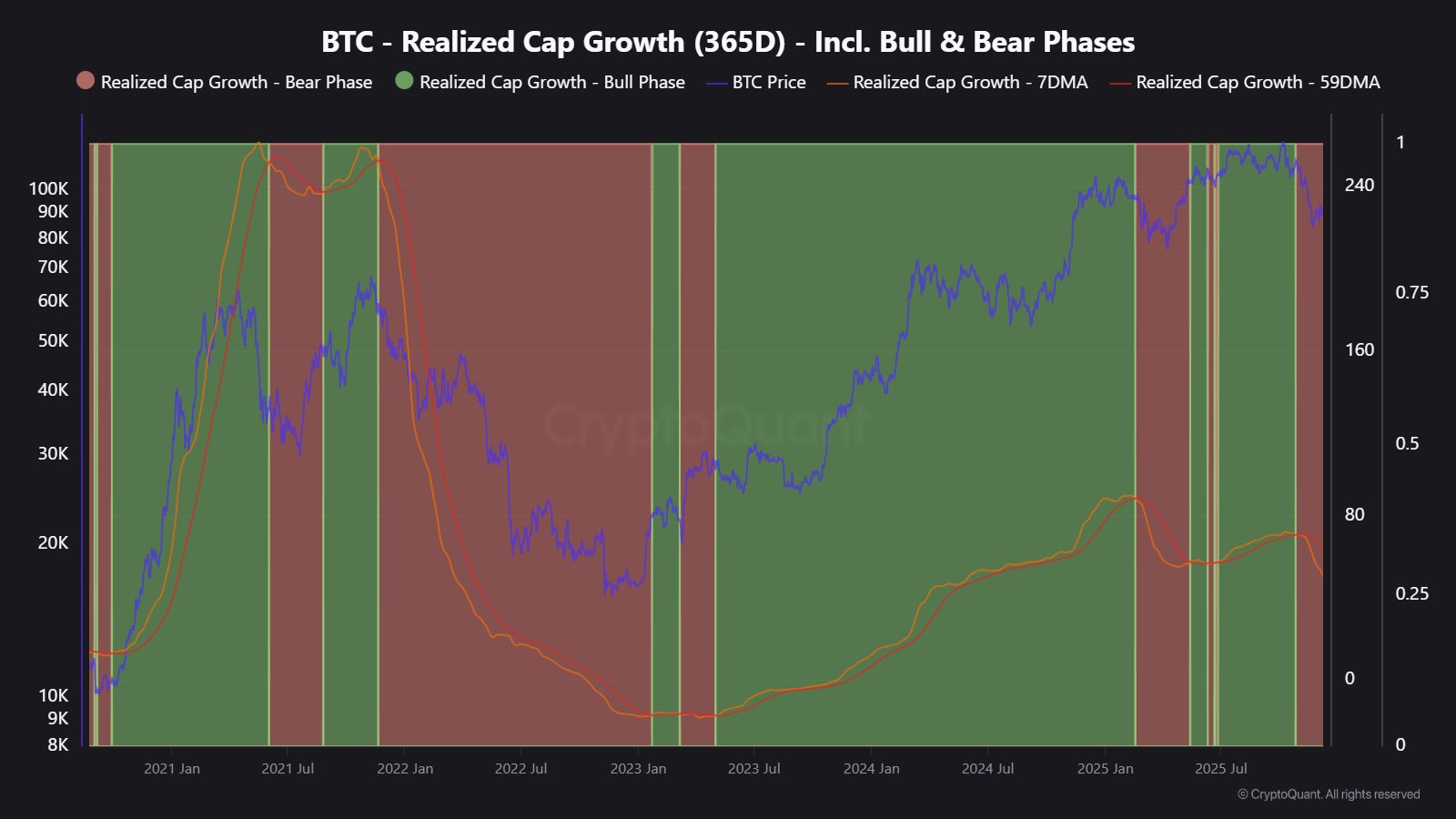
Note the accompanying visualization of Realized Cap Growth, which underpins the analysis above. The downward drift in both the 7-day and 59-day moving averages underscores the careful stance many analysts are taking toward near-term upside potential. While this does not negate the possibility of a rebound, it does emphasize that buyers should watch for confirmatory signs—such as a sustained reversal in the MA cross or a notable uptick in on-chain demand indicators—before assuming a lasting breakout.
Beyond the pure on-chain narrative, market participants are also considering the behavior of short-term holders (STHs), a group prone to reacting quickly to volatility and momentum shifts. The latest data show that, despite a broader market rebound from a November low, STHs remain under pressure. This dynamic can be a telltale sign that the market’s near-term risk posture remains cautious, with many participants still sitting in the red or just above breakeven, waiting for clearer signals before committing fresh capital.
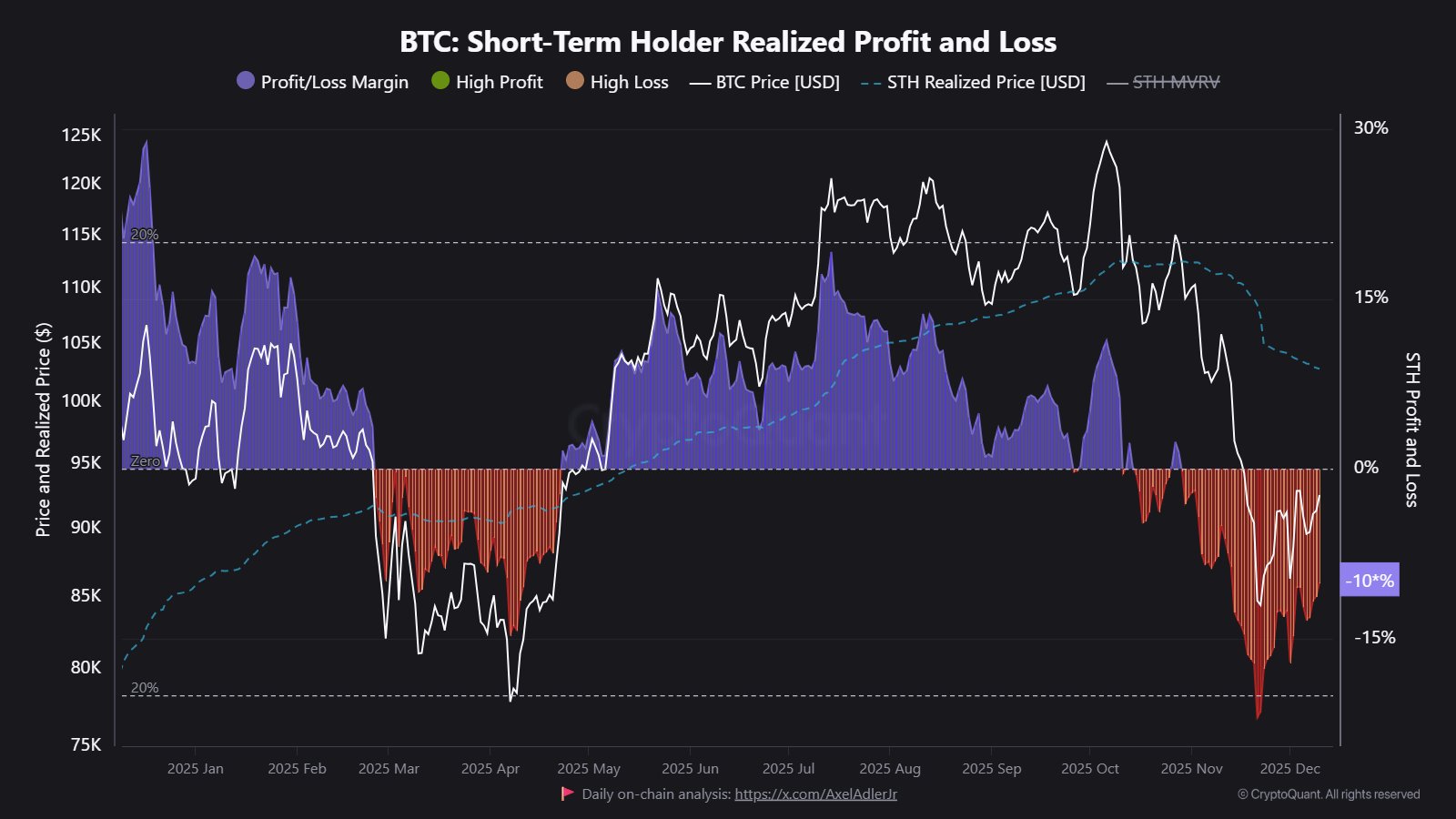
Short-term holders have historically been a barometer of near-term price action. As shown in the chart above, STHs are currently facing a roughly 10% unrealized loss despite BTC’s broader rebound since the November low. For traders, this means that even as price nudges higher, the profits remain fragile and not fully aligned with long-term optimism. Such a distribution of gains and losses within the STH cohort can translate into heightened sensitivity to price moves, increasing the odds of quick profit-taking or stop-triggering moves if volatility spikes again.
BTC Price
As this article is being written, Bitcoin trades around 92,400 USD, reflecting a modest 1.5% decline in the last 24 hours. The price level sits in a zone that has historically triggered both speculative enthusiasm and profit-taking among different investor groups. The current price context matters because it intersects with the Realized Cap Growth narrative: if the price continues to struggle around resistance without a corresponding uptick in real demand, momentum signals will likely stay subdued even if macro conditions appear favorable in other markets.

The price chart from TradingView helps illustrate the short-term dynamics: a price hovering near a critical resistance band, with a history of significant pullbacks when liquidity dries up and new buyers fail to step in with conviction. In such environments, traders often pivot to a cautious approach, prioritizing risk controls like tighter stop-loss placement, deferred entries at better price levels, and a focus on on-chain cues beyond price alone. The interplay between a weak Realized Cap Growth signal and a flat-to-down price trajectory is a reminder that the absence of momentum doesn’t equal a guaranteed downtrend, but it does raise the bar for bullish bets to prove themselves with real buying pressure.
Putting the Signals Together: What It Means for Investors
When analysts talk about momentum, it is not just about the direction of price; it’s about the consistency and source of demand behind moves. Realized Cap Growth offers insight into the quality of capital inflows, while price action reflects how willing the broader market is to translate that demand into new highs. Right now, the combination of a declining Realized Cap Growth and a price that’s not convincingly breaking out suggests a risk-on environment that requires patience and disciplined risk management.
Here are practical takeaways for different types of market participants:
- Long-term investors (HODLers and believers in Bitcoin’s role as a store of value) should watch for sustained on-chain demand signals, such as increasing accumulation by large holders or sustained hop-on activity at strong support levels, rather than chasing every upward tick in price.
- Short-term traders might prioritize risk management and liquidity, looking for clear confirmations from the on-chain suite (including Realized Cap Growth levelling off or turning up) before taking new positions.
- Institutional players and funds evaluating on-chain signals should consider the Realized Cap Growth alongside macro liquidity and policy shifts, recognizing that a lack of fresh cost-basis inflows may necessitate a longer time horizon or alternate entry strategies.
- Miners and mining economics audiences should monitor Realized Cap signals as part of a broader stress-test on network demand and hash-rate dynamics, especially in periods of price stagnation where mining economics can influence capitulation or resilience.
Temporal Context, Statistics, and Pros/Cons
Temporal context matters because on-chain signals are inherently time-sensitive. The latest readings reflect a snapshot of momentum, not a prophecy. The 7-day and 59-day MA cross is a short- to medium-term signal, and while it has historically warned of slower cycles, it has not always signaled the exact turning point of a price trend. In the current cycle, the price sits around 92k, a familiar plateau in a market that has tested several times whether buyers will step up with stronger conviction. The 24-hour price change and the daily volatility juxtapose this, illustrating a market that sometimes moves on macro news while on-chain data keeps whispering a more measured, data-driven narrative.
Pros of the current pattern include the potential for a durable consolidation that reduces whip-saw volatility and improves the odds of a clean breakout if the next influx of buyers arrives with meaningful size. Cons include the possibility that the market remains range-bound for longer than anticipated, delaying the next leg up and inviting opportunistic selling from traders who chase momentum when price fails to decisively clear resistance.
In terms of broader market context, the Bitcoin narrative continues to hinge on macroeconomic conditions, regulatory developments, and evolving adoption. The on-chain signals, while informative, function best when paired with traditional technical analysis and macro risk assessment. That blend helps investors avoid overreliance on a single metric and promotes a more resilient approach to portfolio management in a field that remains highly dynamic and susceptible to news-driven moves.
Conclusion: What This Means for the Road Ahead
Bitcoin Lacks Fresh Momentum As Realized Cap Growth Still Declining captures a moment in the cryptomarket where on-chain realities and price action align toward caution. Realized Cap Growth’s downward trajectory, paired with an underwhelming push from short-term holders, suggests that the market is not yet entering a phase of vigorous new capital inflows. This does not spell doom, but it does underscore the importance of patient positioning, diversified risk, and a steady focus on fundamental signals that provide clarity beyond price swings.
For readers of LegacyWire, the core message is clear: stay informed about the on-chain context, acknowledge the signals that hint at momentum fatigue, and approach trades with a plan that accounts for potential range-bound behavior. As the data evolve, the next meaningful catalyst—be it macro shifts, policy changes, or elevated on-chain activity—could tip the balance toward renewed momentum or reinforce the current pause. Either way, a thoughtful, research-backed approach remains the best path for navigating Bitcoin’s ongoing story.
FAQ
- What is Realized Cap Growth?
Realized Cap Growth measures the year-over-year change in Bitcoin’s Realized Cap, indicating net inflows or outflows of capital based on the last-on-chain transaction price of each coin. It helps gauge momentum more precisely than price alone. - Why does Realized Cap Growth matter for momentum?
Because it reflects how much new capital is entering or leaving the market relative to the cost basis of the existing supply. When it trends up, it often signals stronger accumulation; when it trends down, momentum may weaken as new buyers slow down. - How should investors interpret a MA cross where the 7-day MA crosses under the 59-day MA?
This is typically seen as a bearish momentum signal in the near term. It suggests that recent inflows are weaker than longer-term inflows, which can precede slower price gains or pullbacks unless offset by fresh demand. - What role do short-term holders play in the current picture?
STHs provide a near-term perspective of investor sentiment. If they’re still in losses or marginal gains despite price rallies, it indicates that many buyers may be waiting for more convincing evidence of durable upside before committing new capital. - Can Bitcoin still rally despite these signals?
Yes, it’s possible. Signals like Realized Cap Growth and MA crosses are probabilistic, not deterministic. A major macro catalyst or a surge in on-chain demand could change the trajectory quickly. - How should a long-term investor use this information?
Long-term investors should treat these signals as a guide to risk management, not as a call to abandon positions. Look for sustained on-chain demand, a reversal in Realized Cap Growth trends, and solid price action with strong volume before adjusting core exposure.
Leave a Comment