
Crypto Hedge Funds Pivot to Stablecoins Ahead of Rate Cut as Data Signals a Familiar Pattern
Bitcoin is holding firm above the $92,000 level after rebounding from a brief dip to $90,000, but market sentiment remains decisively bearish. The backdrop is a looming December FOMC decision, with traders bracing for heightened volatility and the potential for rapid liquidity shifts. Even as the crypto market shows signs of stabilization, confidence is fragile, and participants are moving with caution rather than conviction.
In a detailed assessment, XWIN Research Japan reveals a striking shift among crypto hedge funds and large institutional players toward a clear risk-off posture. On-chain data shows a notable divergence: BTC balances on centralized exchanges are shrinking while stablecoins such as USDT and USDC are accumulating on exchanges. This pattern signals a deliberate build-up of liquid reserves that can be deployed quickly depending on the Fed’s rate decision.
This rise in stablecoin exchange reserves is a textbook case of event-driven hedging. Institutions are preparing for volatility rather than betting on a binary directional move. Historically, such positioning appears when markets anticipate meaningful policy decisions that could reshape near-term liquidity conditions and risk tolerance.
Crypto Hedge Funds Retreat To Stablecoins Ahead of Rate Cut: A Familiar Pattern Revisited
Funding rates offer a clearer lens into the market’s true positioning than price alone. The XWIN Research Japan report emphasizes that, during the August–October 2025 window, funding rates surged as short-term traders piled into long positions ahead of the anticipated Fed decision, only to unwind dramatically once the outcome was announced. This pattern mirrors the classic playbook around rate-cut cycles: a pre-event rally fueled by expectations, followed by a swift post-announcement deleveraging and price pullback.
Bitcoin’s price behavior has tracked that sequence as well. The pre-event spike, driven by optimism about a policy shift, often gives way to a sharp reversal when leveraged positions are forced to unwind. The current environment shows similar dynamics, with a cautious tilt rather than a confident directional bet shaping the market’s trajectory.
The report underscores several telltale signs of cautious institutional behavior. CME futures open interest has paused, suggesting that big players are avoiding high-conviction directional bets as the FOMC week approaches. Whale spot holdings remain largely unchanged, indicating that major investors are choosing defensiveness over accumulation. In contrast, stablecoin inflows continue to accelerate, a hallmark of event-driven hedging as large capital remains on the sidelines, ready to act when the policy signal becomes clear.

“Whether the Fed moves or not, volatility tends to spike during FOMC week,” notes the XWIN Research Japan report. The real risk for traders is chasing the pre-meeting bounce without honoring the historical tendency for post-announcement shakeouts. The winning approach remains risk management and disciplined hedging rather than trying to predict the exact policy outcome.”
From a broader market perspective, the current pattern aligns with a well-documented, recurring cycle: pre-announcement optimism, followed by a period of deleveraging and price normalization after the policy decision is public. In this environment, the role of risk controls—position sizing, stop placements, and scenario planning—rises to the top of the list for asset allocators and fund managers alike. Investors should note that the most durable gains in such episodes often come from being prepared to pivot quickly rather than lingering in overleveraged bets.
Total Crypto Market Cap Holds Key Support But Lacks Momentum
The Total Crypto Market Cap chart suggests a stabilization around $3.1 trillion after a multi-week decline. This level sits just above the 100-week moving average, a historically important support zone that has often acted as a battleground for the market’s longer-term trajectory. Holding this line prevents a more acute breakdown and reduces the probability of a retest toward the $2.7–$2.8 trillion zone, which would imply a deeper corrective phase.
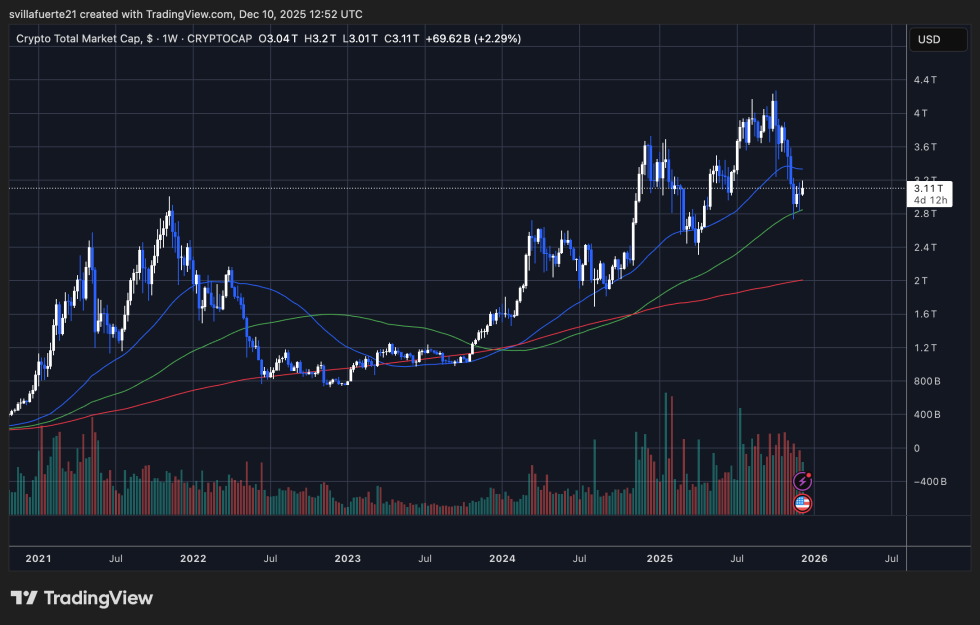
Despite the bounce, the chart tells a different story: the market remains structurally fragile. Trading below the 50-week moving average—now bending downward—signals waning momentum across flagship assets like Bitcoin, Ethereum, and major altcoins. The absence of a meaningful surge in volume on the rebound reinforces the notion that institutional conviction is still cautious heading into the FOMC decision and the broader macro narrative remains uncertain.
For bulls, a decisive reclaim of the $3.3–$3.4 trillion zone would shift the momentum back toward risk-on appetite, sparking a broader recovery. Without that breakout, the recent bounce risks being judged as corrective rather than the start of a sustained up-leg. In practice, traders will be watching a confluence of signals: price action around that resistance cluster, the behavior of stablecoin inflows, and the evolving risk-on/off balance across institutions.
From here, a core question emerges: is the market at a crucible moment or merely treading water? The answer hinges on how macro drivers unfold and whether demand returns with enough velocity to push the market above critical thresholds. The absence of a robust momentum build, coupled with ongoing macro uncertainty, makes the near-term path highly conditional and dependent on the Fed’s signal in December and the accompanying narrative about liquidity and risk tolerance.
The macro backdrop remains the most potent driver of crypto market dynamics. The Federal Reserve’s stance on rate cuts and the pace of policy normalization carry implications that ripple through risk assets, including digital currencies and their on-chain ecosystems. In a world where policy moves ripple through liquidity conditions, stablecoins become more than just a convenient hedge; they transform into strategic liquidity cushions that enable rapid repositioning should volatility spike or fade unexpectedly.
Analysts emphasize that the FOMC week is a period of amplified price discovery and heightened risk management. While the probability distribution around the rate cut may shift day to day, the most reliable takeaway is that volatility tends to peak around the decision window. Traders who ignore this historical pattern risk being caught in a scramble as positions rush to unwind in the wake of the announcement. Institutional traders, in particular, prioritize hedging and liquidity preparedness over crystal-ball forecasting, recognizing that the post-announcement environment often contains a plenitude of fast-moving risk scenarios.
Another layer of complexity comes from cross-market signals. CME futures offer a gauge of how institutions are pricing risk in the near term. When open interest stalls, it’s a hint that big actors are pacing themselves, waiting for clearer guidance from the Fed. This restraint complements the on-chain narrative of rising stablecoin reserves and shrinking exchange balances, painting a cohesive picture of a market that is choosing to stay nimble rather than commit to aggressive directional bets.
On-chain activity continues to diverge from on-exchange equity bets, a trend reinforced by the behavior of large holders. Whale activity in spot markets has not surged, even as the broader market attempts a rebound. This divergence is consistent with a risk-off posture—investors seeking to protect capital by reducing exposure to price swings and preserving dry powder for a clearer entry point after policy clarity emerges. In short, the macro environment is not yet conducive to a breakout; it is more aligned with a cautious consolidation that leaves room for a volatile but contained macro narrative.
Where the Liquidity Is Heading
As institutional players retreat to stablecoins, the liquidity picture reveals a two-pronged strategy. First, it preserves optionality—having stablecoins on hand means capital can be redeployed swiftly into the most favorable risk-reward setups after the FOMC decision. Second, it minimizes exposure to sudden liquidity shocks that could accompany a policy surprise or a liquidity squeeze across crypto markets. This dual approach underscores a broader theme: the market is prioritizing flexibility and resilience over exposure to outright speculative bets at this juncture.
From a risk-management perspective, this pattern offers a practical takeaway for traders and fund managers. The emphasis should be on liquidity quality, counterparty risk, and the speed with which hedges can be deployed or unwound. The goal is not to predict the exact outcome of the rate decision but to survive a period of elevated volatility with controlled risk and preserved optionality for the next phase of the cycle.
For professional investors, the current climate reinforces several core principles that have stood the test of prior rate-cut cycles. First, liquidity management matters more than directional bets. The ability to quickly shift from a risk-off stance to a risk-on posture as conditions evolve is a competitive advantage in the current regime. Second, on-chain data remains a critical tool for assessing market heat and potential stress points. When centralized exchanges shed BTC balances and stablecoins accumulate, it signals more than a temporary drift; it signals a structural reallocation of risk and capital intensity inside the crypto ecosystem.
Third, a disciplined approach to hedging is essential. Event-driven hedging—where investors position for potential volatility rather than a specific price move—has historically proven effective during policy decision weeks. Stablecoins provide the speed and liquidity required to enact such hedges without taking on additional directional risk. Funds that emphasize robust risk controls, transparent disclosures, and clear governance frameworks tend to weather FOMC-driven volatility more effectively than those relying on leverage-driven momentum strategies.
From the retail perspective, the lesson mirrors the professionals: stay informed about macro signals, monitor on-chain indicators, and be cautious about chasing pre-announcement rallies. The risk of a sharp reversal after the policy decision remains real, particularly when leverage has accelerated in the days leading up to the event. For newcomers, this is a reminder that crypto markets are highly sensitive to macro policy shifts, and patience with selective exposure is often a prudent stance during FOMC weeks.
- Monitor stablecoin inflows: A continued rise in stablecoin reserves on exchanges is a sign of risk-off hedging rather than bullish conviction.
- Watch funding rates: A spike in funding rates that collapses after the event suggests a leveraged chase that unwinds post-announcement.
- Track exchange balances: Decreasing BTC balances on centralized venues imply institutions are reducing direct market exposure.
- Assess macro signals: The policy path, including rate-cut timing and forward guidance, will shape the risk-on/off balance for weeks to come.
- Consider liquidity readiness: If you hold crypto assets, maintain liquid liquidity and protect against abrupt liquidity droughts during surprise moves.
- Balance risk and return: Favor hedged positions or strategies with built-in risk controls over unhedged directional bets in this phase.
The current environment—marked by a cautious institutional stance, rising stablecoin reserves, and selective on-chain signals—paints a picture of a market that is prioritizing resilience over aggression. The “Crypto Hedge Funds Retreat To Stablecoins Ahead of Rate Cut” narrative is not a sign of panic; it’s a disciplined response to a high-uncertainty macro landscape where liquidity, risk management, and timing matter most. As the Fed’s December meeting approaches, the odds favor volatility with a bias toward continuation of a risk-off posture until policy clarity emerges and liquidity conditions stabilize. The market’s next move will probably hinge less on a single catalyst and more on how participants assimilate the policy signal into their hedging playbooks and liquidity strategies.
In this environment, LegacyWire remains committed to unpacking the data, decoding the narratives, and explaining how macro decisions ripple through crypto markets. Our coverage will continue to emphasize what investors really need to know: actionable insights grounded in on-chain signals, macro context, and clear risk-reward frames. Whether you are managing a hedge fund, a family office, or a personal portfolio, the path forward will be defined by disciplined risk management and the ability to adapt quickly to evolving market conditions.
FAQ
- What does rising stablecoin reserves on exchanges indicate? It signals a risk-off posture, with institutions preserving liquidity to deploy quickly if volatility spikes or if they need to reallocate in response to macro or policy shifts.
- Why are funding rates important in this context? Funding rates reveal how traders are positioned in the perpetual swaps market. A spike followed by rapid deleveraging often points to a crowded trade that reverses after a major event like an FOMC decision.
- How should investors interpret the Total Crypto Market Cap’s plateau around $3.1 trillion? It indicates resistance against a deeper pullback, but the lack of strong momentum suggests the market is in a wait-and-see mode until macro clarity improves.
- What is the typical pattern around rate-cut cycles in crypto markets? Historically, markets rally ahead of the decision on expectations of favorable policy, then experience a post-announcement shakeout as investors unwind leveraged bets and reassess risk exposure.
- What practical steps should a risk-conscious investor take now? Emphasize liquidity readiness, reduce leverage, use hedging instruments if appropriate, and diversify to shield against a potential post-announcement volatility spike.
Sources cited in this analysis include XWIN Research Japan and CryptoQuant data visualizations, as well as referenced market commentary from CryptoQuant’s funding-rate insights and CME futures indicators. The synthesis aims to deliver cautious, evidence-based guidance tailored for professional cohorts and informed retail readers alike.
Leave a Comment