
Ethereum Longs Surge as Leading Whale Traders Put Over $425M on the Line
Ethereum has reclaimed the $3,150 level after a volatile stretch, offering a rare sign of strength in an otherwise uncertain market. The broader crypto landscape remains sharply divided: some analysts argue that ETH and the rest of the market still face downward continuation, potentially setting new local lows, while others believe this correction is simply a reset before a much larger bull cycle—possibly extending into 2026.
Yet one signal stands out clearly amid the noise: smart whales are unanimously going long on ETH. On-chain data shows that several of the most profitable and consistent whale traders—each with tens of millions in realized gains—have opened substantial long positions, collectively exceeding hundreds of millions of dollars. Their coordinated behavior indicates confidence that Ethereum’s recent lows represent opportunity rather than danger.
This alignment among top-performing whales introduces a compelling counterpoint to bearish narratives. While retail sentiment remains fragile, the most sophisticated market participants appear to be positioning for a larger move ahead. As Ethereum stabilizes above $3,150, the question now becomes whether whale conviction will prove to be early—or correct.
Top Performers Load Up on Ethereum
According to data shared by Hyperdash and Lookonchain, some of the most successful and influential whales in the market are aggressively accumulating Ethereum—sending a clear signal that high-conviction players expect upside ahead. The breadth of positions among these traders underscores a theme: when big capital flows into ETH, it tends to move markets in more durable directions than retail activity alone.
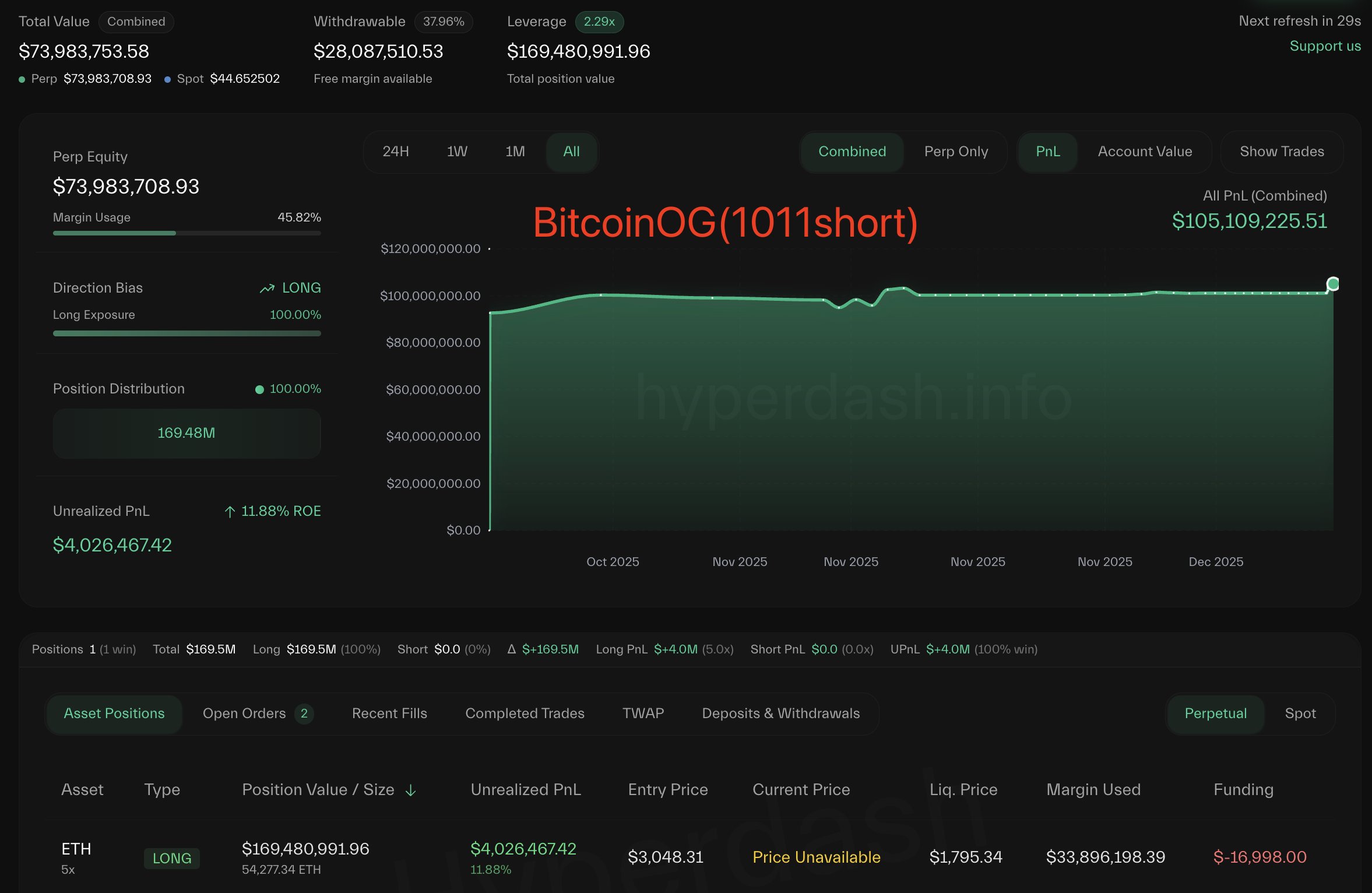
One of the most notable is BitcoinOG, a veteran trader widely recognized for his decisive moves during extreme market stress. With a total realized P&L of about $105 million, BitcoinOG is now positioned firmly on the bullish side, holding 54,277 ETH worth roughly $169.48 million. This allocation represents a high-conviction bet that Ethereum’s current low is a springboard for a broader rally, rather than a signal of imminent chronic weakness.
Another major player is the so-called Anti-CZ whale, a nickname earned by noted behavior of taking the opposite side of positions that Binance founder Changpeng Zhao has favored in the past. This trader carries an impressive $58.8 million in total PNL and is currently long 62,156 ETH—an exposure valued at about $194 million. The pattern here isn’t random; it’s a structural tilt toward long exposure during a period of heightened volatility, suggesting a belief that Ethereum’s next leg higher will outpace macro headwinds and technical pullbacks.
Finally, pension-usdt.eth, a consistently profitable whale address with $16.3 million in realized gains, is long 20,000 ETH valued at $62.5 million. This address illustrates a different archetype: institution-like capital or long-hold strategies that emphasize risk management and steady accrual rather than rapid, high-volatility trades. Together, these three profiles represent a cross-section of the whale ecosystem—with two sides of the same conviction: ETH is on the verge of a meaningful move, and large players want to be positioned for it.
Taken together, these positions reflect a unified stance among top-performing whales: despite market uncertainty, they are positioning for Ethereum strength. The presence of multi-figure long bets from well-known, historically profitable traders lends credibility to the notion that the downside risk has been priced in and that the upside potential remains compelling in the mid-term horizon. For readers of LegacyWire—our aim is to translate these moves into actionable insights and context for both traders and long-term holders.
Weekly Structure Shows Early Signs of Stabilization
ETH’s weekly chart depicts a market struggling to regain footing after a multi-week slide from the $4,500 region. The recent reclaim of $3,150 stands out as a meaningful development, aligning with prior weekly support levels from mid-2024 and sitting just above the 50-week moving average. In market terms, the 50-week MA often serves as a trend-defining zone; traders watch it for evidence of sustained momentum beyond short-term rebounds.
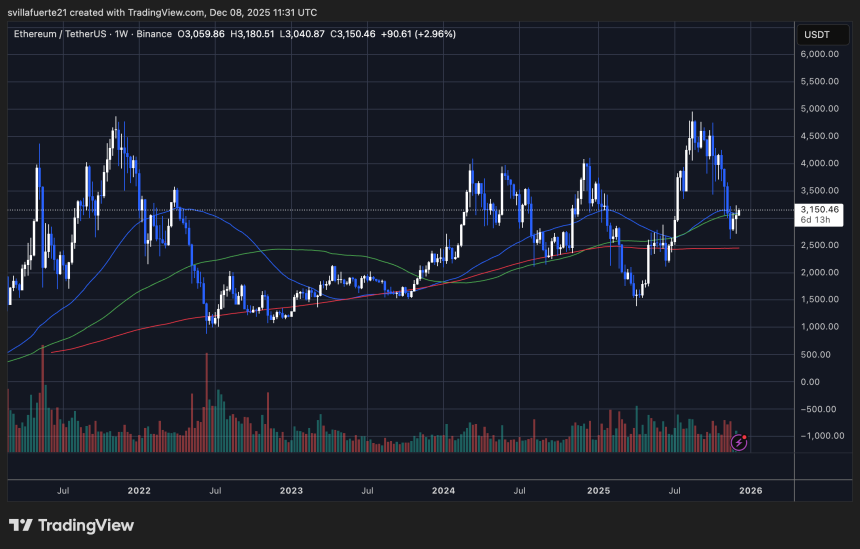
ETH briefly dipped below this critical region during the November selloff, but aggressive buyers stepped in, producing a robust weekly wick that signals demand at lower levels. This kind of price action is not a guaranteed bullish reversal, yet it does add a layer of conviction to the view that the market has found some cushion after a period of stress. In practical terms, it means the path of least resistance could be sideways to higher unless new catalysts emerge that shift risk/reward in a meaningful way.
Despite this recovery signal, Ethereum remains below several key resistance thresholds. The 20-week and 100-week moving averages sit above the current price, and they are converging in a way that can create a tough boundary to breach without renewed buying interest. In other words, the market is in a transitional phase: not in a full-blown downtrend, but not yet showing a durable, high-timeframe bullish breakout either.
Volume patterns reinforce this narrative. Selling pressure has waned versus the capitulation seen in earlier weeks, while recent green candles indicate a measured accumulation. This isn’t a market sprint back to the old highs; it’s a gradual reallocation of risk as buyers reenter at more favorable levels. For traders, the practical takeaway is to watch how volume behaves around the $3,200–$3,300 zone in coming days. A sustained push above this corridor could lay the groundwork for a retest of the $3,600–$3,800 range, while a failure to hold the $3,150 level increases the risk of a test of the $2,800 support region.
From a risk-management perspective, the current setup favors patient, disciplined exposure. The presence of large long positions from whales provides a frame of reference for potential upside, but it doesn’t erase the probability of volatility-driven drawdowns. Traders should calibrate position sizes, set clear stop-loss levels, and be prepared for choppy price action as market participants weigh macro cues and on-chain dynamics in near-real time.
On the macro side, several cross-currents influence the near-term trajectory. Global macro liquidity, central bank signals, and evolving DeFi narratives all play a role in shaping ETH’s risk-reward balance. The resilient nature of on-chain activity—despite price retracements—signals that participants may be accumulating ahead of a broader cycle. In LegacyWire’s view, the hammer of evidence is pointing toward accumulation rather than capitulation, but the market will require a compelling catalyst to clear the resistance zone decisively.
On-Chain Signals and Market Sentiment
Beyond the headline whale plays, on-chain indicators corroborate a cautious optimism that has emerged in late 2025. The alignment of long positions among high-probability traders is a notable sentiment shift that counters the more dour retail narrative still circulating in social channels and general market chatter. When the smartest money shows conviction, it tends to influence other market participants by shaping expectations about where prices could go next.
Several on-chain metrics deserve attention for readers who want a deeper read into what the whales are signaling. First, realized gains for top addresses show that profit-taking for these traders has remained disciplined. Rather than chasing late-stage momentum, these addresses have deployed capital into fresh ETH exposure while preserving capital in other areas of their portfolios. That pattern suggests a strategic, risk-adjusted approach rather than a blind bet on a quick bounce.
Second, the accumulation trend among top addresses is not isolated to a single trader cohort. Across multiple wallets—ranging from seasoned veterans to institutions-like profiles—the consistent move toward net long exposure reinforces the case that the ETH market could be at the threshold of a new leg higher. This convergence is important because it implies that the Tank of Market Makers is signaling, not merely a couple of lucky bets.
From a workflow perspective, on-chain data serves as a complementary lens to price charts. In a market that often moves on momentum and narrative, the hard data of wallet balances, position changes, and realized P&Ls can help investors avoid herd mentality traps. For a readership of LegacyWire, it matters that these signals align with credible fundamentals and credible market logic rather than hype alone.
What This Could Mean for Short-Term and Long-Term Trajectories
The central question for traders and investors alike is this: does the current whale alignment indicate an imminent breakout or a longer consolidation before a major cycle? The answer likely lies in the interplay between technical breakout dynamics and the ongoing evolution of on-chain activity. In the near term, Ethereum’s ability to sustain trading above the $3,150–$3,200 zone will be a critical litmus test for the health of the current move.
Short-term scenarios to consider include a retest of the $3,200–$3,300 barrier, followed by a potential push toward the $3,600–$3,800 range if buyers sustain momentum. This pathway would align with a broader re-accumulation phase that often precedes a real acceleration in price action. Conversely, a breach of $3,150 could shift the risk environment back toward a more cautious stance, with the next support around $2,800 acting as a potential safety net for risk-averse traders.
On the longer horizon, the presence of high-conviction long exposure among whales raises the possibility of a larger bull phase that could extend into 2026. If macro conditions support risk-on sentiment and ETH sustains elevated on-chain activity, the market could begin to price in a more durable cycle rather than a mere bounce from oversold levels. In practical terms, this would translate into higher probability trades, better risk-reward ratios, and a renewed appetite for strategic allocation rather than opportunistic speculation.
From a fundamental perspective, Ethereum’s role in the evolving blockchain ecosystem remains robust. The network’s transition toward scalable, secure, and decentralized finance use cases continues to attract developers, institutions, and long-horizon investors. In the current milieu, the whale-driven long exposure reinforces a narrative of structural demand—one that could be resilient even if short-term volatility spikes recur. For LegacyWire readers, the story remains clear: durable upside potential coupled with thoughtful risk management is the prudent stance in a market where big players have just shown their hand.
Pros and Cons of Whale-Driven Moves
- Pros:
- Enhanced price discovery as institutional-like players enter long positions.
- Potential for more sustained upside when large capital supports a trend.
- On-chain signals corroborate price action, adding credibility to the bullish thesis.
- Cons:
- Whale moves can be followed by sharp pullbacks if risk-off sentiment returns.
- Liquidity and market depth can still be fragile in certain sessions, causing slippage.
- Overreliance on a single narrative (whales as a predictor) can distort risk assessment for retail traders.
In practice, a balanced approach matters. The presence of high-conviction long exposure supports a constructive view, but it should be paired with active risk management, diversification, and a clear plan for entries and exits. For readers of LegacyWire, the takeaway is not to chase the highest leverage or the loudest calls, but to align exposure with a well-structured strategy that respects both on-chain signals and traditional technicals.
Conclusion
The recent alignment among top-performing Ethereum whales marks a notable inflection point in the current cycle. As ETH reclaims critical support and medium-term moving averages, the market is watching for sustained momentum, not merely a bounce. The combination of credible on-chain activity, price stabilization, and the presence of long exposure from investors with proven track records provides a compelling narrative for a potential new leg higher. That said, traders should remain vigilant for signs of exhaustion or renewed macro headwinds that could test the resilience of this setup.
For a publication like LegacyWire—dedicated to providing timely, evidence-based updates on important market moves—the story is clear: the smart money is signaling a bullish tilt on Ethereum, but prudent risk controls are essential in an environment where volatility remains elevated. The coming weeks will be telling as ETH navigates a critical juncture between consolidation and a possible new cycle of growth. Our coverage will continue to distill on-chain activity, price action, and macro factors into actionable insights for readers who rely on solid analysis rather than hype.
FAQ
What does it mean when whales go long on Ethereum?
When large, historically successful traders increase long exposure to ETH, it generally signals a belief that prices are more likely to rise than fall in the near to medium term. It doesn’t guarantee a rally, but it often precedes improved demand dynamics and can influence other market participants to adjust their own expectations. For everyday investors, this can indicate a favorable risk-reward setup, especially if supported by on-chain data and technical indicators.
Are whale-driven moves reliable indicators for the next price move?
Whale activity is a valuable signal, but it should be weighed alongside fundamentals, technicals, and macro context. Large players can influence price through liquidity provision and risk-sharing, yet sudden shifts in sentiment or liquidity risk can override their positions. The most trustworthy use of whale activity is as one data point within a broader decision framework, not as a sole predictor.
How should a retail trader respond to this signal?
Retail traders should avoid impulsive bets and instead consider proportionate exposure, risk controls, and defined scenarios. If your plan accommodates a potential retest of key levels (e.g., $3,150–$3,200) with a clear stop, you may participate in a controlled way. If you’re more risk-averse, observe price action, liquidity, and volume around resistance zones before committing capital.
What are the key levels to watch on the chart right now?
Near-term attention centers on the $3,150–$3,200 support and the $3,200–$3,300 zone as a potential springboard for further upside. Resistance clusters lie around the $3,600–$3,800 range, with additional overhead at higher levels if momentum accelerates. A break above or below these thresholds will shape the next phase of the trend.
How should I interpret this news in the context of a bull market cycle?
If the large long positions prove durable and are supported by continued on-chain activity, the evidence points toward a broader bull phase that could extend into 2026. However, a cautious stance remains warranted until price action clears meaningful resistance and sustains positive momentum across multiple timeframes.
What are the risks I should consider with ETH in late 2025?
Key risks include macroeconomic shocks, regulatory developments, shifting liquidity conditions, and potential liquidity crunches during high-volatility episodes. In addition, if a macro risk-off environment returns, even meaningful on-chain demand can be temporarily overshadowed by selling pressure. Diversification and disciplined risk management remain essential.
In sum, the narrative is nuanced: the strongest wallets are positioning for ETH upside, yet the market is still negotiating a delicate balance between risk and reward. LegacyWire will continue to deliver clear, data-driven coverage, helping readers separate signal from noise as Ethereum navigates this critical phase of its trajectory.

Leave a Comment