
Ethereum Spot Volume Weakening: Futures Dominate Price Direction
Ethereum (ETH) has experienced a significant retracement from its recent peak of $3,240, currently testing the $3,150 support level – a crucial area for traders analyzing momentum. Bulls are attempting to defend this level after a modest rebound, but uncertainty remains high as the market seeks to establish a clear direction following weeks of volatility and aggressive selling. While some analysts view this consolidation as a prelude to a recovery, others warn that ETH could still be vulnerable to deeper pullbacks if momentum fails to strengthen. The recent decline in spot volume, coupled with the increasing influence of futures markets, suggests a shift in market dynamics.
Darkfost, a prominent analyst, highlights a key dynamic: when spot volume thins out, futures often dominate volatility. This shift accelerates both upward and downward movements, depending on trader positioning. With ETH now sitting at a critical support zone, the market awaits clearer signals from the futures market to determine whether this rebound can evolve into a sustained recovery or merely represent a temporary pause.
Futures-Driven Momentum and Volatility
Darkfost expands on this point, noting that when spot volumes weaken to the extent seen over the past few days, the risk of heightened volatility increases sharply. Thin spot liquidity means fewer buy and sell orders are available to absorb sudden moves, allowing futures-driven momentum to exert an outsized influence on price. This environment often produces sharper swings and rapid directional shifts, as leveraged traders and algorithmic strategies dominate short-term market behavior. The increased volatility is a significant factor contributing to the current market uncertainty.
ETH Weekly Structure and Support Levels
Ethereum’s weekly chart reveals a market attempting to stabilize after a steep downturn from the $4,500 region. ETH has rebounded toward $3,140, reclaiming its 100-week moving average (green line), a historically important support level that often defines the boundary between mid-term bullish and bearish phases. This bounce signals renewed demand at a critical zone, especially after the strong wick rejection seen near $2,700, where buyers stepped in aggressively. The weekly trend remains neutral to slightly bearish.
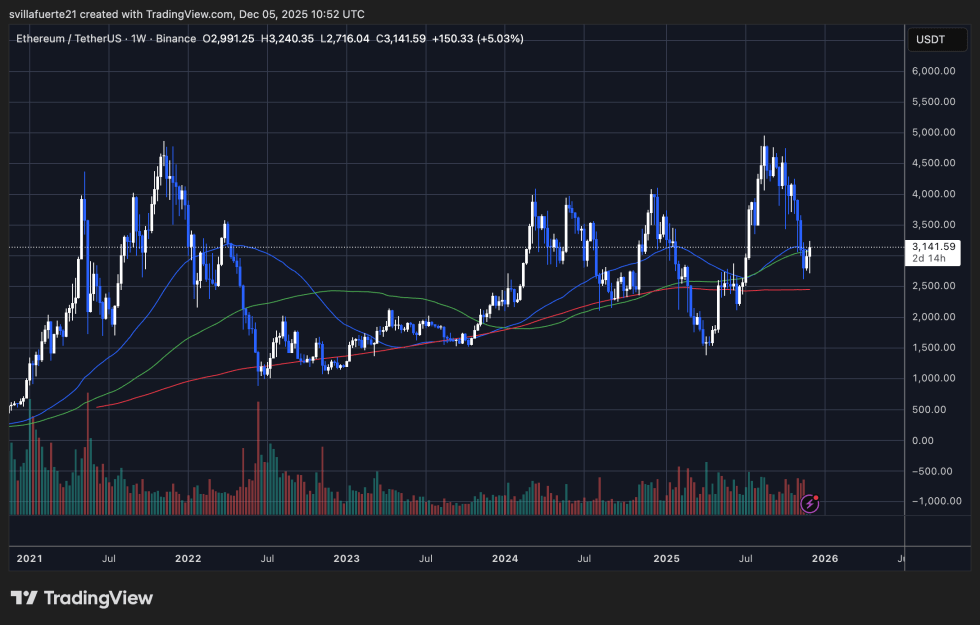
However, Ethereum still faces meaningful resistance overhead. The 50-week moving average (blue line), now hovering near $3,400–$3,500, has flipped into resistance and remains the next major hurdle for bulls. A successful reclaim of this zone would materially improve ETH’s technical structure and open the door to a challenge of higher levels. Until then, the weekly trend remains neutral to slightly bearish.
The Role of Futures in Ethereum’s Market
The futures market is tilting upward, providing a constructive force that is helping Ethereum hold above the $3,150 support zone. Darkfost emphasizes that this upward pressure from futures could work in the bulls’ favor, as volatility—if it expands to the upside—may push the spot market to follow the same trajectory. A sustained futures-led rebound could act as the spark needed for a broader recovery, especially if spot buyers gain confidence and begin re-entering the market.
However, this setup cuts both ways. Without stronger spot participation, any reversal in futures positioning could quickly translate into accelerated downside pressure. For now, Ethereum sits in a delicate phase where volatility is both a potential catalyst and a potential threat, making the next few sessions crucial for determining the market’s short-term direction.
Key Considerations & FAQs
Q: What is the significance of the 100-week moving average for ETH?
A: The 100-week moving average is a historically important support level, often defining the boundary between mid-term bullish and bearish phases. It provides a crucial anchor for ETH’s price action.
Q: Why is the futures market influencing ETH’s price?
A: Futures markets exert an outsized influence on volatility, accelerating both upward and downward movements. Thin spot liquidity allows futures-driven momentum to dominate short-term market behavior.
Q: What are the potential risks for ETH?
A: Without stronger spot participation, any reversal in futures positioning could quickly translate into accelerated downside pressure. The market remains volatile, presenting both opportunities and risks.
Q: What is the overall outlook for ETH?
A: The market is currently in a period of uncertainty, with both bullish and bearish forces at play. The next few sessions will be critical for determining the market’s short-term direction.
FAQ:
- Q: What is the current price range for ETH?
- A: Currently, ETH is trading around $3,150 – $3,400.
- Q: Is there a specific event that could trigger a significant price movement?
- A: The recent decline in spot volume and the increasing influence of futures markets are key indicators to watch.
- Q: Can you provide a forecast for ETH’s price movement in the next week?
- A: Predicting short-term price movements is challenging, but the current market dynamics suggest a cautious approach.
Leave a Comment