
Ethereum’s Rally Has Room to Run: Where Demand Must Grow Next
Ethereum has surged past the $3,350 threshold, delivering a fresh burst of momentum after weeks of ambiguity and debate across trading desks. Yet even with this breakout, the mood remains cautious, tempered by the specter of a broader bear-market structure that analysts keep flagging. Traders now stand at a crossroads: is this the start of a durable recovery, or a temporary lift before another leg lower? The answer hinges on where demand actually comes from and how participants are positioned in the derivatives market.
In a landscape defined by on-chain data and market psychology, CryptoQuant’s latest findings illuminate a subtle but crucial shift. One of the most telling gauges right now is Ethereum’s funding rate behavior across major exchanges. Unlike the dramatic funding spikes seen during the two major rallies earlier this year, the current move shows unusually restrained funding activity. Those earlier surges featured aggressive long leverage, signaling euphoric expectations that often preceded short-term tops. Today, the dynamic looks materially different.
This time, funding remains muted, suggesting that the rally is not being propelled by outsized leverage. The absence of rampant long positioning raises the question: is this a healthier accumulation phase, or simply a lack of conviction that could fade quickly if buyers pause? As Ethereum edges toward the next decisive phase, investors watch closely to see whether demand broadens beyond a small cadre of participants and whether spot buying can sustain a longer rally.
Why “Muted Funding” May Signal a Cautious But Constructive Rally
The CryptoQuant report underscores a key distinction from prior exuberant episodes. While earlier rallies witnessed funding rates climbing into overheated territory, the current moment shows funding that remains comparatively subdued even as price climbs off the sub-$2,800 troughs earlier in the year. This pattern implies that the market is digesting gains with a more measured tone, avoiding the kind of speculative debt accumulation that typically foreshadows quick reversals.
There are meaningful implications for different market participants. By-and-large, buyers are entering the scene, but with modest leverage. That means spot accumulation—actual purchases of ETH on the market—plays a bigger role in driving this move than futures-driven speculation. In practical terms, the rally may have room to extend if fresh buyers keep stepping in, yet it also lacks the fuel of a broad, leveraged crowd that would power a rapid, self-reinforcing ascent.
This nuanced backdrop matters for the sustainability of the move. When funding rates stay low, shorts can continue to press back on price without the compel of massive longs being forced to cover. Conversely, the absence of overheating reduces the risk of an abrupt, sentiment-driven top caused by liquidations and cascading leverage. The path forward, then, hinges on whether demand can broaden and intensify beyond the current cohort of participants.

From a strategic standpoint, the current setup may represent a healthier base for longer-term upside. If demand begins to broaden—through new entrants, institutional interest, or stronger retail engagement—the market could see a more robust uptrend with less risk of a sudden reversal triggered by crowded speculative bets. However, the flip side is clear: without a material uptick in leverage or a clear signal of renewed conviction, the rally could stall at resistance, forcing prices to consolidate rather than push decisively higher.
Testing Key Resistance as Momentum Builds
Looking at Ethereum’s daily chart, the price rally from the sub-$2,800 floor has been steady rather than explosive, with a cautious stride higher as buyers nibble at higher levels. The next critical test sits near the $3,320 zone, a level that has defined the recent price action and could act as a hinge for future trajectory.
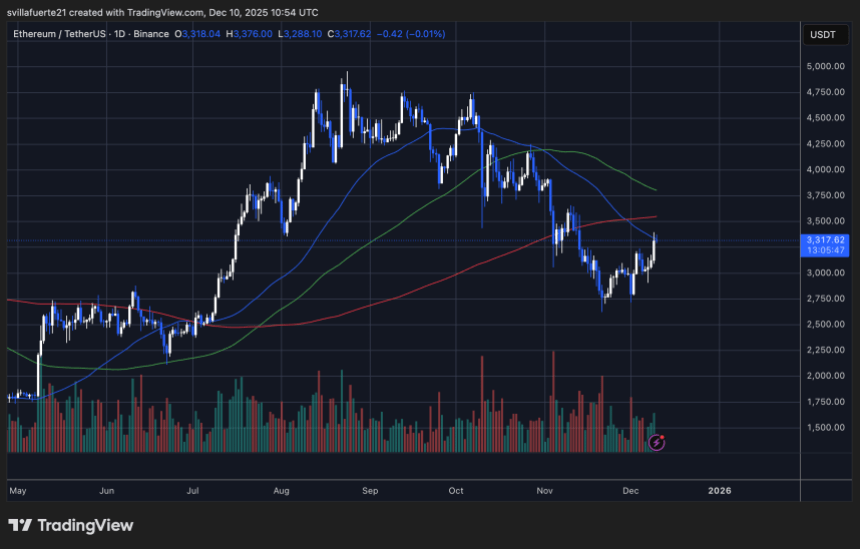
Beyond the immediate hurdle at $3,320, traders will keep a close watch on the 200-day moving average—the long-term trend gauge that can flip the narrative when reclaimed. As Ethereum approached this red line, market commentary often framed it as a potential inflection point: reclaiming the 200-day average has historically marked a transition from corrective phases into renewed bullish cycles. Yet a clean breakout cannot be assumed, given the broader macro and liquidity backdrop of late 2025.
The price action also features a pattern of higher lows since the November capitulation-like drop, a sign that some buyers are gradually accumulating. This is a positive development: it hints at a foundation of demand, even if the volume behind the move remains modest. For momentum to gain sustained traction, the market will need a noticeable uptick in volume that confirms broad-based participation and not just a handful of large buyers.
From a technical standpoint, the 50-day and 100-day moving averages sit above the current price, which reinforces the view that Ethereum remains in a broader downtrend despite the recent bounce. In practical terms, bulls must push convincingly through the $3,350–$3,400 resistance band, a zone that has previously served as both support and springboard for higher prices. If the price can clear this area with convincing volume, the next leg higher could become self-sustaining; if not, the rally risks stalling and reversing.
What these dynamics mean for different market players
For traders who focus on futures and leverage, the muted funding environment reduces the immediacy of risk-versus-reward dynamics tied to margin calls. Yet it also implies fewer catalysts to ignite a powerful short-squeeze scenario. In other words, the current setup favors patient, value-driven participants who are willing to accumulate on dips while waiting for a stronger macro or on-chain signal to accelerate momentum.
Long-term holders, in contrast, may interpret the present phase as a quiet brewing period—one that could precede a more meaningful upcycle if demand broadens. The critical caveat remains: without a credible surge in demand, any upside run risks becoming a correction rather than a trend. The market’s next moves will likely hinge on a combination of on-chain activity, investor sentiment shifts, and external macro catalysts.
Demand, Accumulation, and the Hidden Drivers of the Rally
A central theme in this cycle is the shift from purely speculative momentum to genuine demand that can sustain a longer-term rise. Several factors are at play:
- Spot accumulation versus derivatives speculation: A larger portion of buy pressure appears to be originating from the spot market rather than aggressive leverage in futures. This dynamic tends to produce steadier, more sustainable gains and reduces the risk of a rapid reversal caused by forced liquidations.
- On-chain activity and activity quality: Higher activity on Ethereum’s network—such as token transfers, contract interactions, and gas demand—can underpin a healthier uptrend. When on-chain indicators align with price strength, the probability of a durable rally increases.
- Institutional interest: The entrance of institutions can supply durable demand and longer-term capital. While retail demand often drives initial breakouts, institutions can help sustain a rally through risk-off periods and market downturns.
- Macro liquidity and risk appetite: Broader market conditions, including liquidity cues from major central banks and geopolitical stability, influence risk-on/risk-off cycles that Ethereum’s price often tracks.
These drivers work in concert. If evaluation metrics improve—such as lower funding costs for long positions, higher on-chain activity, and more robust cash inflows into ETH-focused funds—the rally could gain a second wind. Conversely, if spot demand plateaus and derivatives remain cautious, the rally may encounter resistance without a clear path to higher highs.
Resistance, Support, and the Path Forward
To frame possible outcomes, it’s important to map the known resistance and potential breakout zones. The $3,350–$3,400 region has emerged as a critical chokepoint. A successful breakout through this zone, accompanied by volume expansion, would strengthen the case for a renewed bullish phase and could reframe Ethereum’s market structure as more constructive than corrective.
On the downside, the immediate support sits near the $3,000 level, with the broader base of around $2,900 acting as a psychological anchor for buyers who previously experienced a drawdown. If price action moves below these levels with convincing volume, the risk-reward calculus shifts toward a deeper retracement and a test of lower supports, potentially extending to the $2,800–$2,900 band that marked the late-2024/early-2025 consolidation.
For traders who track risk-reward, these zones create a clear framework: assume a bullish bias only if price reclaims the 200-day moving average with corroborating volume, and maintain caution if price fails to sustain above the key resistance while volume remains tepid.
Risk Scenarios: What Could Undermine the Rally?
No market analysis would be complete without a candid look at potential pitfalls. Several risk factors could derail the current upmove, even if the headline figures remain constructive:
: If overall market liquidity tightens or if a major risk-off event rattles risk assets, Ethereum could experience sharper reversals than the current pace would justify. : A sudden drop in on-chain activity or a shift in user engagement away from active DeFi or NFT use could sap the fundamental drivers behind the rally. : Regulatory headlines or policy clarifications can impact price action by altering the cost and feasibility of participating in Ethereum markets, especially for sophisticated players. : If rival networks gain traction in decentralization, security, or throughput with credible use cases, capital could rotate away from Ethereum into alternatives offering better near-term growth narratives.
In practice, a balanced view would acknowledge the possibility of a protracted consolidation phase even as the underlying demand remains steady. The market could trade within a broad range for weeks or months while fundamental catalysts slowly accumulate, setting the stage for a longer-term uptrend when the timing aligns with macro and on-chain signals.
The Macro Backdrop and Ethereum’s Seasonal Context
Beyond the microstructure of funding rates and moving-average dynamics, the broader macro environment matters. The path of interest rates, inflation data, and global economic resilience all interact with crypto markets in non-linear ways. In late 2025, the liquidity landscape has shown pockets of resilience but also caution, as investors weigh the prospect of slower growth against inflation readings and potential policy shifts. Ethereum’s sensitivity to risk appetite means it often rallies when liquidity is abundant and sentiment improves, but stalls when the appetite for risk wanes.
Seasonality is another factor to consider. Historically, certain quarters have tended to be more forgiving for risk assets around technological upgrades, network milestones, or positive regulatory signals. While not a guaranteed predictor, seasonal patterns can add a tailwind in the presence of constructive fundamentals and robust demand.
What This Means for Different Stakeholders
For traders focused on short- to medium-term moves, the prudent approach is to monitor funding rates, volume spikes, and price extensibility beyond the key resistance levels. A breakout with high-volume confirmation would warrant a shift toward more aggressive positioning, with careful risk controls in place to navigate potential pullbacks.
For long-term holders and believers in Ethereum’s role within the stack of decentralized finance and smart contracts, this phase represents a period of watchful optimism. The absence of overheated leverage is a meaningful signal, suggesting that the rally could evolve into a more sustainable ascent if demand broadens and strong on-chain activity continues to accumulate.
Developers, projects, and institutional allocators should keep a close eye on the fundamental growth narrative: the pace of network activity, the adoption of Layer-2 solutions to improve scalability, and the health of the DeFi ecosystem on Ethereum. These factors help determine whether price strength translates into durable network value and long-term capital inflows.
Practical Takeaways for Investors and Traders
: A decisive break above this line, supported by volume, could mark a shift toward a more constructive market structure. : Subdued funding suggests caution but also a potentially healthier base for longer-term upside if demand widens. : Increases in transaction counts, active addresses, and gas demand can provide corroborating evidence for a sustainable rally. : With resistance at $3,350–$3,400, traders should set clear lines for profit targets and stop levels to manage downside risk. : Don’t rely solely on a single metric. Combine price action, volume, funding rates, and on-chain indicators for a holistic read.
Conclusion
In the current moment, Ethereum’s rally exhibits a nuanced signature: price strength without overheating, a foundation built on spot accumulation rather than explosive leverage, and a resistance landscape that demands a convincing breakout to convert into a durable uptrend. The pace of demand growth—whether it originates from retail onboarding, institutional participation, or a surge in on-chain activity—will determine whether this move evolves into a substantive, long-lasting development or remains a guarded corrective uptick.
For now, the case rests on a balance between cautious optimism and disciplined risk management. If demand broadens, if volume sustains through the key resistance zone, and if the 200-day moving average is convincingly reclaimed, Ethereum could extend its rally with more conviction. If not, a period of sideways movement or a shallow pullback could follow, with buyers waiting for a more robust catalyst to reignite momentum.
LegacyWire – Only Important News will continue to monitor on-chain signals, market structure, and macro indicators that shape Ethereum’s trajectory. The next few weeks could be pivotal in confirming whether this rally is the onset of a durable bull phase or a last breath before another leg lower. Stay tuned for updates grounded in data, context, and expert analysis.
FAQ
- What signals indicate Ethereum’s rally has real staying power?
The emergence of sustained volume, a convincing breakout above the 200-day moving average with healthy confirmation candles, and a broad-based increase in on-chain activity would signal staying power. A shift from spot-led gains to liquidity-driven, leveraged momentum would also bolster a durable uptrend.
- Why are muted funding rates considered a double-edged signal?
Muted funding rates suggest limited speculative leverage, which reduces the risk of a rapid top. But they can also reflect a lack of conviction that could slow a rally if buyers don’t step in with stronger demand. The combination calls for patience and a watchful eye on liquidity-driven catalysts.
- How important is the 200-day moving average for Ethereum?
Historically, reclaiming the 200-day moving average has marked transitions from correction to sustained bullish momentum. It acts as a long-term trend gauge, so traders pay close attention to price action in relation to this line and accompanying volume.
- What role does on-chain activity play in Ethereum’s price action?
On-chain indicators—such as active addresses, transaction counts, and gas used—help validate whether price moves are backed by real user activity and ecosystem growth, rather than purely speculative trading.
- Could regulatory news derail Ethereum’s rally?
Yes. Regulatory developments can shape market sentiment and risk appetite, affecting every crypto asset. Traders should stay informed about policy updates that could influence participation costs and compliance requirements.
- What would constitute a bullish breakout scenario?
A clean break above the $3,350–$3,400 resistance with strong volume, followed by extended price action that stabilizes above the breakout level and attracts new buyers, would be a defining bullish signal.
- Is this improving, or merely a pause before the next drop?
It depends on demand breadth. If buyers broaden beyond the current cohort and there is evidence of sustainable accumulation, the rally could gain momentum. If demand remains narrow and price action stalls, a pullback remains a credible risk.
- What should long-term investors watch next?
Key indicators include on-chain growth metrics, the pace of development on Layer-2 scaling solutions, and the health of the DeFi ecosystem on Ethereum. These factors influence the network’s long-term value proposition and capital inflows.
- How does this update reflect Ethereum’s overall market position?
The analysis points to Ethereum maintaining its central role in the crypto ecosystem, with a rally that could become more durable if demand expands, network activity strengthens, and macro conditions cooperate.
Leave a Comment