
Shibarium Rebounds With New Update as Shiba Inu Whales Return
Following its 2023 debut, Shibarium emerged as a beacon for the Shiba Inu ecosystem, a Layer-2 network promised to accelerate transactions and unlock real utility for SHIB holders. Yet, as the months rolled on, on-chain activity and user adoption cooled, dampening the early hype and leaving investors searching for a fresh driver. Now, with the emergence of ShibOS—an ambitious operating system intended to anchor the Shiba Inu universe—the talk of a revival is back on the table. Added to this revival thesis is a notable uptick in on-chain whale activity, hinting that large holders are reevaluating their stance and potentially laying the groundwork for a new leg higher. This article digs into what’s changing, why it matters for SHIB, and how investors might navigate the evolving landscape of Shibarium, ShibOS, and the broader Shiba Inu ecosystem.
Shibarium launched as a Layer-2 blockchain designed to scale the Shiba Inu network and broaden its use cases. For a time, it looked like a catalyst that could lift SHIB beyond meme-stage dynamics into a more utilitarian crypto asset with real-world applications. But the past year brought a quiet period—fewer active users, slower developer momentum, and a price response that frustrated even the most optimistic SHIB believers. The narrative, however, is shifting as ShibOS takes shape and more developers and business partners begin to explore what a blockchain-powered operating system can enable. The core idea is simple and bold: create a unified platform where brands, Web3 builders, and the Shiba Inu community can co-create a growing ecosystem of dApps, digital identities, and scalable services built on Shibarium’s L2 framework. If ShibOS gains traction, the resulting network effects could feed back into Shibarium demand, potentially expanding transactions, users, and ultimately SHIB utility.
Shibarium Revival Could Take Shape With The Adoption Of ShibOS
Throughout much of the year, Shibarium faced headwinds. Activity dwindled, and the number of daily active users waned as developers paused or redirected their efforts elsewhere. This stagnation created a testing ground for new strategies and a pivot toward a broader platform vision. ShibOS is at the center of that pivot. Described as a specialized operating system for the Shiba Inu ecosystem, ShibOS aspires to bridge traditional businesses with Web3 developers, enabling smoother integration of blockchain features into real-world workflows. The goal is not merely to create speculative tokens but to embed SHIB into practical applications, from loyalty programs to supply-chain verification, from identity services to decentralized finance (DeFi) primitives that offer meaningful, audited value to users and enterprises alike.
The logic behind ShibOS rests on a more mature model of blockchain adoption. Rather than positioning SHIB as a static meme asset, ShibOS aims to host a growing suite of containerized services, self-governed digital identities, and interoperable blockchain features that can be embedded into both consumer and enterprise products. In practice, that means a framework for Decentralized Applications (dApps) and user-centric identities, offering a gateway for Web2 brands to experiment with blockchain without starting from scratch. The community-centric architecture would, in theory, incentivize developers to build, test, and deploy on Shibarium, turning user sessions into on-chain activity and turning that activity into real, measurable value for the ecosystem.
From a strategic perspective, the ecosystem is pursuing several parallel benefits. First, more robust dApps create higher transaction throughput and more meaningful on-chain economics, which can improve the network’s utility score and reduce bottlenecks that historically dampened user adoption. Second, a strong self-sovereign identity framework can help users control their data while enabling permissioned, privacy-preserving interactions—an important consideration in enterprise use cases. Third, the alignment with Web2 brands offers a potential on-ramp for non-crypto users to experiment with blockchain concepts through familiar interfaces and business logic. Taken together, ShibOS enlarges the total addressable market for Shibarium beyond hobbyists to mainstream developers and corporate partners.
In practical terms, if developers begin adopting ShibOS and integrating it into products, Shibarium could experience a natural uplift in activity. More applications mean more transactions, a broader user base, and a healthier on-chain economy. That virtuous cycle could, in turn, lift demand for SHIB as the native fuel of the ecosystem, reinforcing a positive feedback loop that supports price discovery. It’s a subtle but potentially powerful shift: from a single-token meme narrative to a platform-backed, utility-driven ecosystem with real-world use cases. Such a transition would be a defining moment for Shiba Inu, signaling maturity and resilience in a crowded crypto landscape.
Shiba Inu Whale Activity Hits Six-Month High
On the data front, sentiment is warming as whale metrics have begun to move higher. Recent analysis shared by SanSights on Santiment shows SHIB whale activity reaching levels not seen since early June 2025. In the most recent period, multiple large wallets executed 406 individual transactions, each moving more than $100,000 in SHIB. This pattern suggests renewed interest from large holders who may be reallocating capital or positioning for a forthcoming price move tied to ShibOS adoption or broader market catalysts.
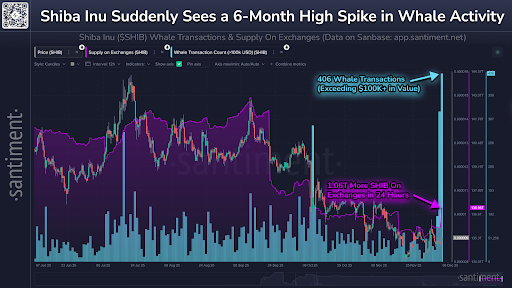
Concurrently, crypto exchanges have seen a sizable increase in SHIB deposits. The data indicates a net addition of approximately 1.06 trillion SHIB into exchanges over a 24-hour window, valued at roughly $15 million to $20 million. This inflow could reflect several possibilities: traders hedging risk ahead of a potential rally, musicians of liquidity preparing for onboarding of new users, or investors simply rotating into liquidity pools and staking arrangements. The near-term interpretation of these deposits remains nuanced, but the alignment of whale activity, exchange inflows, and a rising price environment typically signals a brewing momentum shift. In other words, the market is watching for a coordinated move that could precede a broader trend reversal or acceleration.
All of this momentum appears in a context where SHIB’s price has reacted positively to the renewed on-chain energy. While past cycles have shown that on-chain activity alone does not guarantee a sustained rally, the convergence of growing developer interest, healthier liquidity, and rising whale balances creates a more permissive environment for a breakout. This does not guarantee an immediate rebound to all-time highs, but it does suggest that a tipping point could be near if ShibOS successfully on-ramps traditional industries and crypto-native developers alike.
The broader market backdrop matters here too. In late 2025, the crypto space has seen a shift toward platform-level narratives—where ecosystems like Shibarium can mature into interoperable, utility-driven networks rather than standalone tokens. The potential for cross-chain compatibility, partnerships with payment processors, or integration into Web3-enabled enterprise software could expand the SHIB use case beyond speculative trading. That widening of the ecosystem’s footprint could, over time, translate into steadier on-chain activity, more reliable transaction throughput, and improved governance signals from community members and stakeholders alike.
ShibOS is more than a marketing term; it’s positioned as a strategic backbone for the Shiba Inu universe. The approach emphasizes two critical levers: developer-friendly tooling and enterprise-grade identity and application infrastructure. By offering a structured environment where developers can deploy dApps with less friction and where digital identities are governed within the network, ShibOS could dramatically shorten the path from idea to production for blockchain-enabled solutions. For small teams, startups, or even established brands exploring Web3 pilots, this could be the difference between a concept and a fully functioning application with real users and measurable outcomes.
From a technical angle, the operating system model suggests a modular architecture. This typically means standardized APIs, wallet integration, and security layers that different applications can reuse rather than reinvent. For the user, this could translate into familiar sign-in flows, consistent experiences across apps, and predictable privacy controls. For developers, it reduces the “time-to-market” hurdle and encourages experimentation with new business models, from loyalty programs built on blockchain to transparent supply chains verified by on-chain proofs. If the ecosystem can deliver on these promises, Shibarium could graduate from a speculative layer-2 narrative into a trusted infrastructure for a growing set of real-world use cases.
Of course, every major platform shift carries risk. Adoption requires robust security, reliable uptime, and clear governance processes to prevent fragmentation or runaway complexity. ShibOS will need to demonstrate real-world reliability, an expanding catalog of working apps, and a governance model that aligns incentives across developers, users, and SHIB holders. If these conditions are met, the platform could attract a broader pool of developers, including those who previously labeled Shibarium as experimental. The outcome could be more frequent updates, more integrations, and a healthier feedback loop between developers and users—each reinforcing the other to drive on-chain activity and SHIB demand.
From an economic perspective, a successful ShibOS rollout could alter the supply-demand dynamics around SHIB. A higher volume of on-chain transactions, greater application utility, and a broader base of users would likely increase the token’s velocity and utility as a transaction medium. For investors, this translates into potential upside from both price appreciation and improved staking or yield opportunities tied to the Shiba Inu ecosystem. However, higher activity can also bring increased risk, including network congestion if demand outpaces throughput or governance disputes that could impact the pace of development.
Timeliness matters here. The present moment features a confluence of signals: renewed whale interest, rising exchange deposits, and a price environment that has shown resilience in the face of macro volatility. When combined with a tangible product roadmap for ShibOS and tangible partnerships, these signals can create a more credible bullish case for SHIB. Still, the path forward remains uncertain, and outcomes hinge on execution, community engagement, and the ability to deliver experiential value to users and businesses alike.
- Pros
- Expanded utility for SHIB as the native fuel across a growing ecosystem of dApps and services.
- Stronger developer momentum due to a more approachable ShibOS environment and standardized tooling.
- Potential partnerships with Web2 brands seeking blockchain-enabled loyalty programs and identity solutions.
- Enhanced on-chain activity could improve liquidity and price discovery for SHIB.
- Digital identity framework supports privacy, security, and user control, appealing to enterprise users.
- Cons
- Execution risk: ShibOS adoption depends on real-world product-market fit and developer onboarding.
- Regulatory uncertainty around crypto-based identity and enterprise integrations.
- Competition from other Layer-2 ecosystems and alternative projects with similar visions.
- Reliance on continued community engagement to avoid fragmentation and governance contention.
- Expanded utility for SHIB as the native fuel across a growing ecosystem of dApps and services.
- Stronger developer momentum due to a more approachable ShibOS environment and standardized tooling.
- Potential partnerships with Web2 brands seeking blockchain-enabled loyalty programs and identity solutions.
- Enhanced on-chain activity could improve liquidity and price discovery for SHIB.
- Digital identity framework supports privacy, security, and user control, appealing to enterprise users.
- Execution risk: ShibOS adoption depends on real-world product-market fit and developer onboarding.
- Regulatory uncertainty around crypto-based identity and enterprise integrations.
- Competition from other Layer-2 ecosystems and alternative projects with similar visions.
- Reliance on continued community engagement to avoid fragmentation and governance contention.
Investors eyeing Shibarium’s revival should focus on a few practical angles. First, track the pace of ShibOS development: availability of developer documentation, testnets, and early adopter programs are meaningful leading indicators of future activity. Second, monitor on-chain metrics that reflect activity depth beyond mere price moves—daily active users, transaction counts, new wallet addresses interacting with Shibarium, and the growth rate of dApps deployed on the platform. Third, pay attention to ecosystem partnerships and real-world pilots. Deals with brands that bring consumer-facing applications to the network would signal validation beyond the crypto-enthusiast crowd.
Risk-aware investors might also consider hedging strategies or diversification within the broader Layer-2 space, weighing Shibarium’s potential against peers with parallel trajectories. It’s essential to maintain a disciplined exposure aligned with one’s risk tolerance, time horizon, and conviction about the technology’s ability to deliver practical value. As always, a cautious, research-driven approach matters more than speculative timing in volatile markets.
The last year has demonstrated an important reality: a compelling technology story must translate into real-world adoption to sustain momentum. Shibarium’s revival hinges on whether ShibOS can convert interest into usable products, and whether these products can attract users who stay and transact. In the near term, macro factors—such as funding conditions for crypto projects, consumer demand for digital services, and shifts in risk appetite—will influence the speed and scale of any recovery.
From a statistics standpoint, the six-month high in SHIB whale activity signals that large holders are re-engaging with the asset, but it does not guarantee a sustained rally. The accompanying exchange deposits—amounting to roughly 1.06 trillion SHIB in 24 hours—are a reminder of the heavy liquidity juggling that characterizes this market. Such patterns often serve as precursors to price moves, but they can also reflect repositioning or distribution phases. The prudent takeaway is that the market appears to be positioning for a broader narrative, with ShibOS as the central storyline driving renewed interest in the SHIB ecosystem.
In sum, Shibarium’s revival is less a single event and more a strategic reset anchored by ShibOS. If the operating system can successfully unlock practical use cases, simplify developer onboarding, and support enterprise-grade identities and applications, it could convert ephemeral hype into lasting utility. The renewed whale activity and sizable exchange deposits add a concrete layer of market signal, suggesting that the narrative is shifting from “What is Shibarium?” to “What will Shibarium become?” for real-world users and businesses. The coming months will reveal whether this is a sustainable reawakening or a temporary rally driven by speculation. Either way, LegacyWire will be here to track the developments, interpret the data, and explain what changes mean for the SHIB user, investor, and the broader crypto ecosystem.
FAQ
-
What is ShibOS and why is it important?
ShibOS is described as an operating system designed to support the Shiba Inu ecosystem. It aims to connect dApps, self-sovereign identities, and enterprise-oriented features, creating a structured environment where developers and brands can experiment with blockchain technologies on top of Shibarium. In short, ShibOS could be the platform that turns Shibarium from a speculative layer into a practical, scalable ecosystem.
-
How could ShibOS impact Shibarium’s adoption?
By lowering friction for developers, enabling more predictable architecture, and offering enterprise-ready identity and application solutions, ShibOS could attract a broader set of users and brands. Increased activity would improve network effects, attract more transactions, and ultimately strengthen SHIB’s utility and value proposition.
-
Are SHIB whales back in action?
Recent on-chain data indicates renewed whale activity, with six-month highs in SHIB whale transactions and notable large transfers. While this signals renewed interest from large holders, the longer-term impact on SHIB’s price will depend on how this interest translates into sustainable demand and network growth.
-
What are the risks associated with a Shibarium revival?
Key risks include execution risk (actual adoption of ShibOS and real-world use), regulatory uncertainty around digital identities and enterprise blockchain applications, potential competition from other platforms, and governance challenges that could slow progress or lead to fragmentation.
-
When could we see meaningful adoption beyond speculation?
Meaningful adoption depends on ShibOS rollout milestones, partner onboarding, and measurable use-case deployments. If early pilots demonstrate tangible value and user engagement scales, adoption could accelerate within the next 12 to 18 months, though timelines in crypto development are inherently iterative and contingent on execution quality.
-
What else should investors watch for?
Monitor developer activity, testnet progress, community governance signals, and new enterprise partnerships. Also watch on-chain metrics beyond price, including active users, transaction throughput, and the number of live dApps on Shibarium. These indicators provide a clearer picture of the ecosystem’s health and trajectory.

Leave a Comment