
Tron Achieves $80.2 Billion Stablecoin Milestone Following Tether’s $1 Billion USDT Minting
In recent months, Tron has distinguished itself as one of the most resilient cryptocurrencies amidst a challenging market environment. While many major altcoins have faced significant declines of 40% or more since August, Tron has managed to limit its losses to just 24%. This impressive performance underscores the network’s unique position and the consistent demand it garners, even in the face of broader market downturns.
A key driver of this resilience is Tron’s increasing prominence within the stablecoin ecosystem. Recent data from Tronscan, as reported by Lookonchain, reveals that Tether has minted an additional $1 billion USDT on the Tron network. This development not only reflects ongoing confidence in Tron’s capabilities but also elevates its stablecoin market capitalization to over $80.2 billion, reinforcing its status as the leading blockchain for USDT transactions.
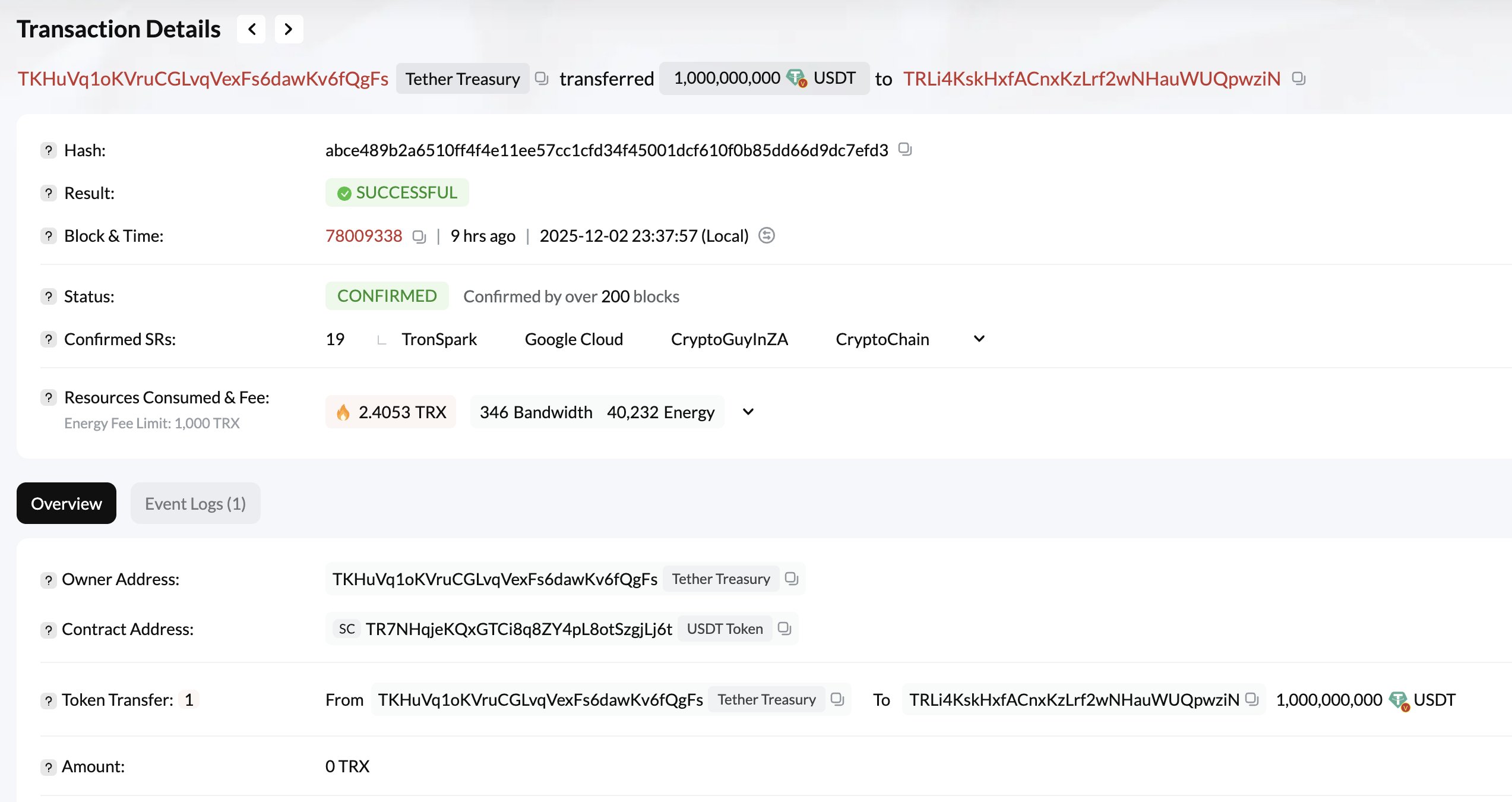
As investors shift their capital defensively into stablecoins, Tron appears to benefit disproportionately. Its ability to maintain relative stability while other cryptocurrencies experience volatility highlights the ongoing utility-driven demand for Tron, suggesting that it may continue to provide support even in turbulent market conditions.
Tron Solidifies Its Role as the Second-Largest Stablecoin Network
Tron has emerged as a cornerstone of the global stablecoin landscape, securing its position as the second-largest blockchain for stablecoin transactions. The network’s appeal stems from its rapid settlement times, minimal transaction fees, and robust liquidity—qualities that make it the preferred choice for high-volume USDT transfers, particularly across exchanges, over-the-counter (OTC) desks, and remittance corridors.
This infrastructure has enabled Tron to attract substantial stablecoin flows, with its total stablecoin market capitalization now surpassing $80.2 billion, largely driven by Tether’s ongoing issuance on the network.
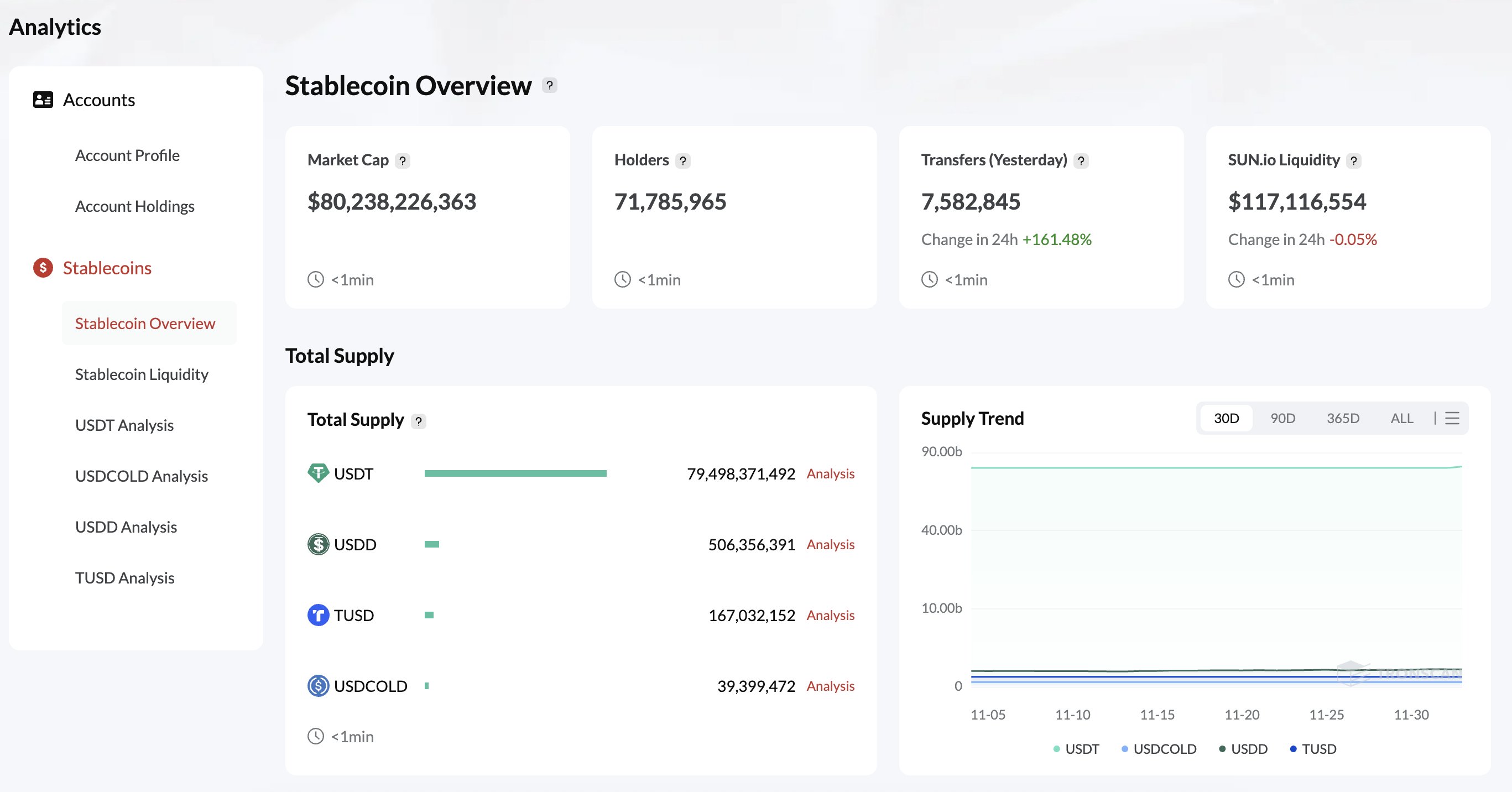
Despite Tron’s remarkable growth, Ethereum continues to dominate the stablecoin market, boasting a market capitalization of approximately $166 billion—nearly double that of Tron. Ethereum’s supremacy is bolstered by its extensive decentralized finance (DeFi) ecosystem, institutional adoption, and the higher-value transactions facilitated through smart contracts, lending protocols, and various on-chain financial applications.
On Ethereum, stablecoins often serve as liquidity for advanced trading and yield strategies, while on Tron, they are primarily utilized for settlement, payments, and exchange flows. The two ecosystems cater to different market needs: Ethereum anchors the institutional and DeFi-driven segment of stablecoin usage, whereas Tron excels in high-throughput, cost-effective transactions. As global demand for stablecoins continues to rise, both networks are likely to reinforce their respective positions—one through scalability and speed, and the other through DeFi depth and capital concentration.
TRX Maintains Strong Weekly Structure Amid Market Volatility
Tron’s weekly performance chart reveals a notable level of resilience compared to the broader cryptocurrency market. While many altcoins have experienced more severe declines, TRX has managed to hold above the $0.27–$0.28 support zone, maintaining a strong higher-timeframe structure. Although the recent market correction pulled the price down from the $0.36 range, TRX continues to trade comfortably above the 50-week simple moving average (SMA), which currently sits around $0.28 and serves as immediate dynamic support.
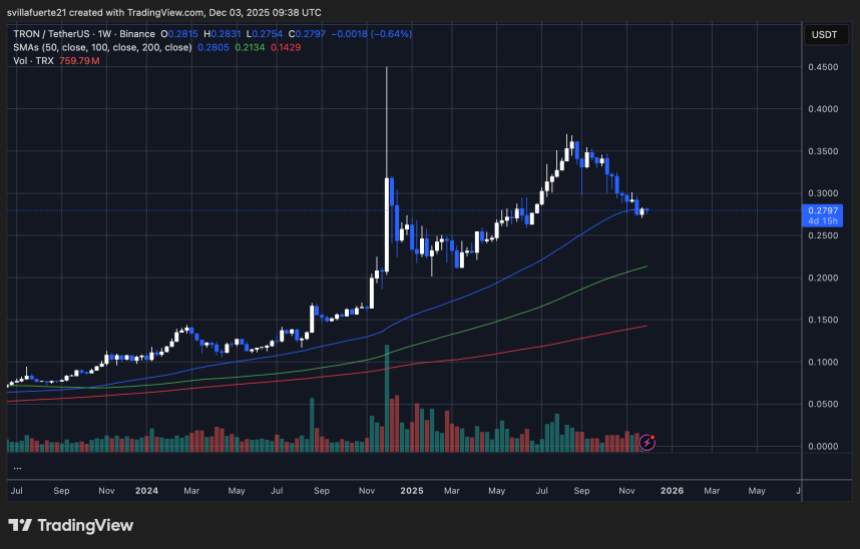
This strength is significant. Throughout 2025, TRX has consistently respected its rising moving averages. The 50-week SMA, in particular, has provided reliable support during each market pullback. The 100-week and 200-week SMAs, positioned well below the current price, indicate a broad, healthy long-term uptrend that remains intact.
For Tron to regain bullish momentum, it must reclaim the $0.30–$0.32 region, which previously served as support during the last uptrend and now acts as resistance. A strong weekly close above this zone could pave the way for a retest of the $0.34–$0.36 highs. Until that occurs, TRX remains one of the more stable performers in the market, demonstrating controlled downside and structural strength.
Understanding the Stablecoin Ecosystem: Key Components and Trends
The stablecoin ecosystem is a complex landscape that plays a crucial role in the cryptocurrency market. Understanding its key components and trends can provide valuable insights into how networks like Tron and Ethereum operate within this space.
What Are Stablecoins?
Stablecoins are cryptocurrencies designed to maintain a stable value by pegging them to a reserve of assets, typically fiat currencies like the US dollar. This stability makes them ideal for transactions, trading, and as a store of value. There are three primary types of stablecoins:
- Fiat-Collateralized Stablecoins: These are backed by reserves of fiat currency, such as USDT (Tether) and USDC (USD Coin).
- Crypto-Collateralized Stablecoins: These are backed by other cryptocurrencies, often over-collateralized to account for price volatility. Examples include DAI and sUSD.
- Algorithmic Stablecoins: These use algorithms to control supply and demand, adjusting the supply of the stablecoin based on market conditions. Examples include TerraUSD (UST) and Ampleforth (AMPL).
Current Trends in the Stablecoin Market
As of 2026, several trends are shaping the stablecoin market:
- Increased Adoption: More businesses and individuals are using stablecoins for transactions, remittances, and trading.
- Regulatory Scrutiny: Governments are increasingly focusing on regulating stablecoins to ensure consumer protection and financial stability.
- Integration with DeFi: Stablecoins are becoming integral to decentralized finance platforms, providing liquidity and enabling various financial services.
- Technological Innovations: New technologies are emerging to enhance the efficiency and security of stablecoin transactions.
Conclusion
Tron’s recent achievement of surpassing an $80.2 billion stablecoin market cap, following Tether’s minting of $1 billion USDT, highlights its resilience and growing significance in the cryptocurrency landscape. As it continues to solidify its position as the second-largest stablecoin network, Tron demonstrates its ability to attract stablecoin flows and maintain stability amidst market volatility. With ongoing developments in the stablecoin ecosystem, both Tron and Ethereum are poised to play pivotal roles in shaping the future of digital finance.
Frequently Asked Questions (FAQ)
What is Tron and why is it significant in the cryptocurrency market?
Tron is a blockchain-based platform designed for decentralized applications (dApps) and content sharing. Its significance lies in its ability to facilitate high-speed transactions and its growing dominance in the stablecoin ecosystem.
How does Tron compare to Ethereum in terms of stablecoins?
While Tron is the second-largest stablecoin network with a market cap of over $80.2 billion, Ethereum leads with approximately $166 billion. Ethereum’s strength comes from its extensive DeFi ecosystem, whereas Tron excels in transaction speed and cost efficiency.
What types of stablecoins exist?
Stablecoins can be categorized into fiat-collateralized, crypto-collateralized, and algorithmic stablecoins, each with different mechanisms for maintaining price stability.
What are the current trends in the stablecoin market?
Current trends include increased adoption, regulatory scrutiny, integration with DeFi, and technological innovations aimed at improving transaction efficiency and security.
How can I invest in Tron or stablecoins?
Investing in Tron or stablecoins can be done through cryptocurrency exchanges that support these assets. It’s essential to conduct thorough research and consider market conditions before investing.

Leave a Comment